
Read each date as a specific event
A recording date, a studio opening and an album release describe different events. This timeline labels each one rather than forcing them into an invented succession of uniform eras. Country music was made before the commercial records preserved here, and an older recording practice can continue after a newer one appears. The selection is also deliberately incomplete: it follows useful listening comparisons, not the first example of every innovation. Start with the sound of a recording, then use its documented context to understand the choices available to its makers. The genre listening map offers another route through overlapping styles. Here, time explains changing possibilities, while the record itself remains the evidence for what an artist did with them.
1927: Bristol brings technology and repertoire together
The Bristol sessions took place July 25 through August 5, 1927. The Birthplace of Country Music’s teaching materials and Library of Congress account document the field-recording setting and the importance of electrical recording to the resulting sound.12 Bristol was not the moment country music first existed. Its significance lies in a commercially organised encounter among musicians, repertoire, a producer and recording equipment. Hear a Carter Family or Jimmie Rodgers selection for the relationship between voice and accompaniment. A compact recording does not necessarily mean a simple musical tradition: a performer may bring years of practice into a few recorded minutes. The timeline therefore marks the sessions as a preserved commercial milestone, not as permission to erase earlier Black, Indigenous, immigrant or regional musical contributions.
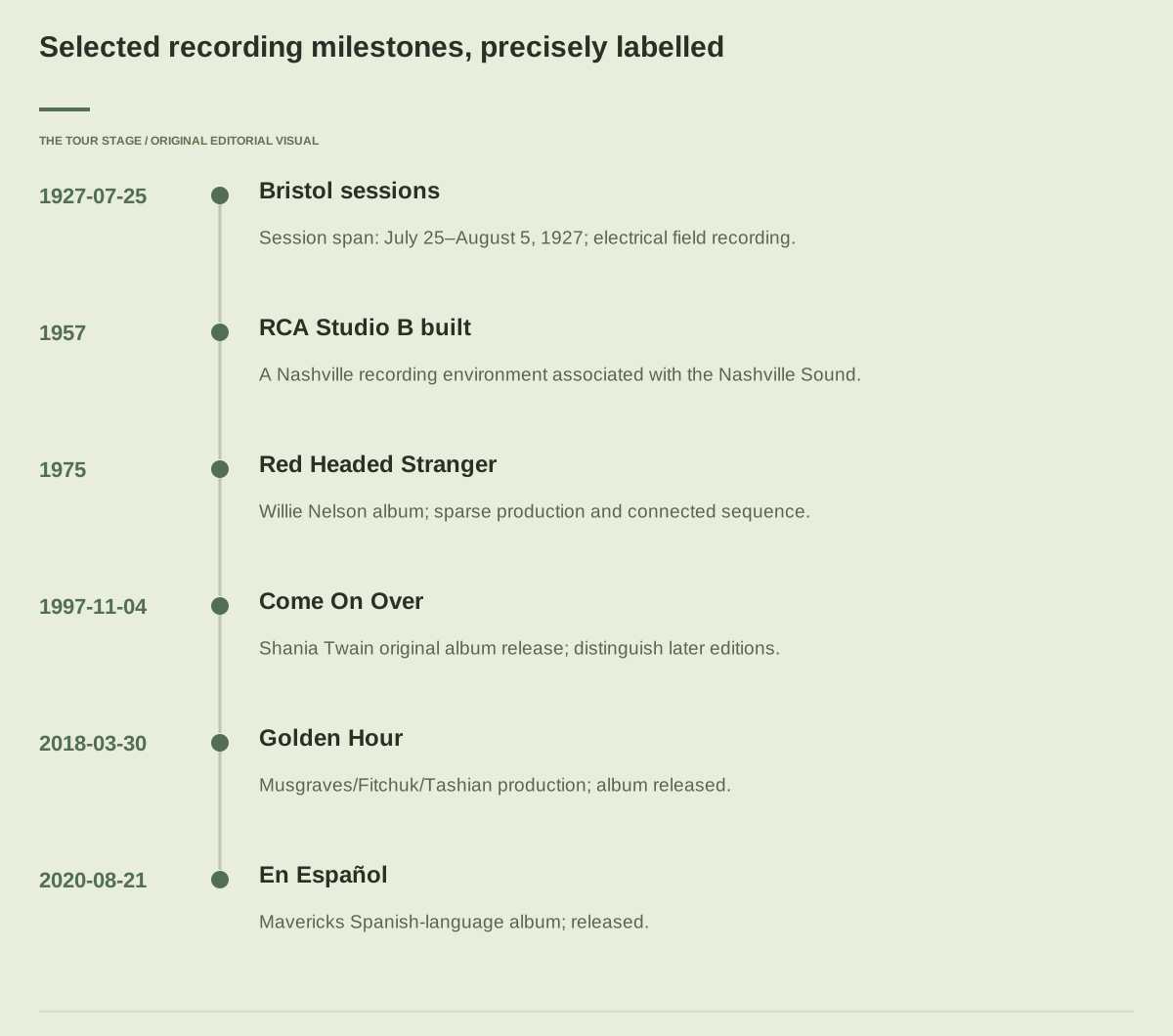
Selected recording milestones, precisely labelled
- 1927-07-25 · Bristol sessionsSession span: July 25–August 5, 1927; electrical field recording.
- 1957 · RCA Studio B builtA Nashville recording environment associated with the Nashville Sound.
- 1975 · Red Headed StrangerWillie Nelson album; sparse production and connected sequence.
- 1997-11-04 · Come On OverShania Twain original album release; distinguish later editions.
- 2018-03-30 · Golden HourMusgraves/Fitchuk/Tashian production; album released.
- 2020-08-21 · En EspañolMavericks Spanish-language album; released.
Read the visual as text
- 1927-07-25 · Bristol sessionsSession span: July 25–August 5, 1927; electrical field recording.
- 1957 · RCA Studio B builtA Nashville recording environment associated with the Nashville Sound.
- 1975 · Red Headed StrangerWillie Nelson album; sparse production and connected sequence.
- 1997-11-04 · Come On OverShania Twain original album release; distinguish later editions.
- 2018-03-30 · Golden HourMusgraves/Fitchuk/Tashian production; album released.
- 2020-08-21 · En EspañolMavericks Spanish-language album; released.
1957: RCA Studio B and the Nashville recording centre
RCA Studio B was built in 1957. The museum connects it with the Nashville Sound and with Chet Atkins’ work as a musician, producer and manager of RCA’s Nashville operation.3 A dedicated recording environment enables repeated collaboration and a recognisable set of working practices, but a building does not produce one identical sound on every session. For a listening comparison, notice background voices, the shape of instrumental fills and how smoothly the arrangement frames the lead. These are musical decisions as well as technical ones. The ballad guide helps hear space and restraint. Do not treat a later polished record as proof that all of its instruments were recorded together or that it used Studio B unless the recording evidence says so.
1975: the album sequence can carry the argument
Willie Nelson’s Red Headed Stranger was released in 1975; his official catalogue and the Library of Congress discuss its spare, connected narrative.45 This is a milestone in how an album can organise listening, rather than the invention of sparse country production. Brief pieces, recurring musical ideas and full songs create a larger journey. Compare the emotional effect of a familiar track heard alone with its placement in the original sequence. Space becomes a structural tool: restraint gives a return or transition greater weight. The listener is asked to remember what came before. The start-to-finish album guide follows that idea across other records. A production history needs these changes of scale alongside changes in equipment, because artists also transform what the recording is for.
1997: Come On Over and multiple recording frames
Shania Twain’s Come On Over was originally released November 4, 1997. Its official anniversary catalogue distinguishes the US and international versions.67 That distinction offers a useful lesson in how production travels. One composition and artist identity can appear within different mixes and market-specific configurations. Compare versions only after identifying them accurately; otherwise a claimed historical difference may simply be a later remaster or a different edition. Listen to the balance of rhythm, guitars and layered vocals, then decide what those changes make more prominent. Twain’s crossover is not explained by a single instrument disappearing. The arrangement’s proportions and the construction of a hook matter. The timeline marks the original release, while edition labels preserve the separate histories around it.
2018: Golden Hour makes stylistic room inside one album
Kacey Musgraves’ Golden Hour was released March 30, 2018, co-produced with Ian Fitchuk and Daniel Tashian.8 Hear how acoustic textures, pedal steel, keyboards and a dance-oriented track can sit inside a cohesive listening experience. The album does not need every song to use the same arrangement. Continuity can come from vocal placement, recurring emotional concerns and an overall sense of space. The annotated listening guide follows its thirteen-track sequence in detail. This milestone is a selected example of stylistic integration, not a claim that country had only just discovered synthesisers, disco rhythms or introspection. History becomes clearer when an album’s particular achievement is described without converting it into an unsupported first.
2020: En Español reframes a band’s recorded identity
The Mavericks’ En Español was released August 21, 2020. The band’s announcement identifies it as its first Spanish-language album and names Raul Malo and Niko Bolas as producers.9 The event marks a specific catalogue change, not the arrival of Spanish or Latin influences in country-related music. The band’s own history already includes those connections. Compare the opening “La Sitiera” with a familiar earlier Mavericks recording, following the dance pulse and instrumental conversation rather than language alone. The Mavericks demonstrate how a long-running musical identity can become newly audible through a different repertoire. That is an artistic production choice even when it does not depend on a newly invented technology. The timeline leaves the earlier roots visible rather than presenting a release announcement as a cultural beginning.
Use the timeline as a set of paired listens
Pick two milestones and listen for one shared problem: how to frame a voice, how to create forward motion, or how to sustain an album’s emotional argument. Then identify the different solutions. Add Vince Gill or Trisha Yearwood between the later milestones to prevent the selected dates from becoming empty decades in your understanding. Their recordings offer further comparisons of precision, warmth and restraint. Write release dates and session dates separately in your notes. A timeline should help you ask what changed and what continued, not teach that music progresses toward one superior modern sound. The most revealing comparison may be the quality an early recording shares with a much later one, despite very different tools and commercial surroundings.
Sources & further reading
- Birthplace of Country Music: 1927 teaching resourceJuly 25–August 5 session span and temporary studio.
- Library of Congress: Bristol sessionsCommercial and recording-technology context.
- Museum: About Studio B1957 construction and Nashville Sound.
- Willie Nelson official Red Headed Stranger catalogue1975 album.
- Library of Congress: Red Headed StrangerNarrative and spare production context.
- Mercury release listing: Come On OverNovember 4, 1997 original release.
- Twain official anniversary editionUS and international edition distinction.
- MCA: Golden Hour available nowMarch 30, 2018 release and producers.
- The Mavericks official release archiveAugust 21, 2020 release and producers.