Know which edition a page describes
The official homepage identifies August 6–8, 2027, at Burl’s Creek, Ontario. At this research check on November 8, 2026, the camping page and FAQ still carry 2026 context. That matters because a current homepage does not automatically update every arrival time or camping instruction elsewhere on the site. Use the published 2027 dates for the diary and treat the older detailed policies below as the documented planning model, subject to the matching edition’s terms.12
Keep a note beside each booking decision stating its source year. A refundable room booked for the correct dates is a different commitment from a campsite bought under specific conditions. This small habit prevents a search result from an earlier summer becoming the only evidence behind a costly travel plan. Check both the heading and the small date information on a policy page.
Count people, sites and admissions separately
The published camping model sells sites rather than individual concert admission. It describes tent, RV, hydro and accessible choices; a campsite includes space for one vehicle but does not itself admit campers to the entertainment area. That separation is the most important piece of the accommodation calculation.2
Make a roster before shopping: who attends every day, who sleeps on site, who travels in each vehicle and who owns the equipment. Divide a shared campsite cost only after confirming everyone fits the chosen product and agrees to the arrangement. Put individual admission on its own line. A friend joining for the afternoon should not be counted automatically as an overnight occupant, while a driver who leaves after setup still needs to follow the relevant vehicle procedure. The festival dashboard can hold the group totals without hiding those distinctions.
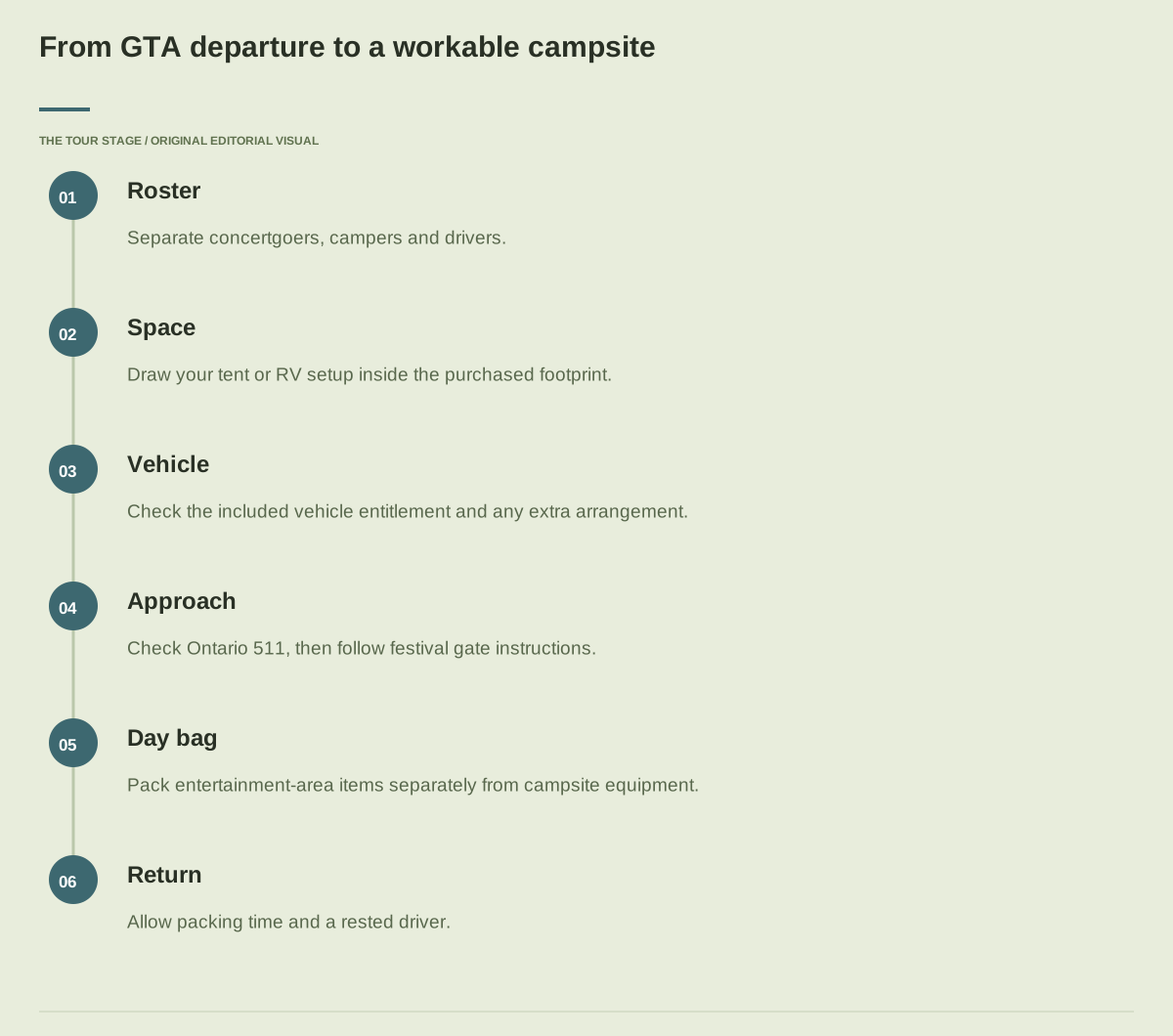
From GTA departure to a workable campsite
- RosterSeparate concertgoers, campers and drivers.
- SpaceDraw your tent or RV setup inside the purchased footprint.
- VehicleCheck the included vehicle entitlement and any extra arrangement.
- ApproachCheck Ontario 511, then follow festival gate instructions.
- Day bagPack entertainment-area items separately from campsite equipment.
- ReturnAllow packing time and a rested driver.
Read the visual as text
- RosterSeparate concertgoers, campers and drivers.
- SpaceDraw your tent or RV setup inside the purchased footprint.
- VehicleCheck the included vehicle entitlement and any extra arrangement.
- ApproachCheck Ontario 511, then follow festival gate instructions.
- Day bagPack entertainment-area items separately from campsite equipment.
- ReturnAllow packing time and a rested driver.
Choose tent camping by footprint and sleeping needs
In the 2026 camping description, standard tent spaces are approximately 20 by 20 feet and XL tent spaces approximately 25 by 25 feet, with up to six people per tent site. Reserved tent camping is described as the method for guaranteeing adjacent spots; other tent options are allocated on arrival, and saving space is not permitted. Reconfirm these dimensions and rules against the product being sold for your edition.2
Do a real layout on paper: tent body, guy lines, vehicle and shared equipment. Six people fitting the occupancy limit does not mean six large tents fit comfortably. Ask each person whether they need a quiet bedtime, a separate sleeping space or easy access to their vehicle. Shared camping works better when those needs are discussed before payment. Decide who brings each essential item and who takes it home. Duplicate bulky equipment creates more problems than an extra phone charger.
Treat an RV as a small operational project
The older RV page describes an approximately 20-by-50-foot space, an eight-person maximum and separate hydro inventory. It also specifies a surge protector for hydro-site RVs. These are useful indicators of the questions to ask, rather than specifications to carry unquestioned into a new booking.2
Measure the entire rig with its towing vehicle and attachments. Ask a rental provider about collection time, insurance, mileage, bedding, power connection and waste service. A motorhome can simplify sleeping while adding a larger journey and return obligation. Nominate someone who understands the systems and keep the handover instructions available. For power-dependent equipment, resolve the precise supply and contingency with the organiser before choosing the site. Do not substitute the word hydro for an answer about the outlet, connection and operation your equipment actually requires.
Plan the Ontario approach from official road information
Burl’s Creek is in Oro-Medonte. Ontario 511, operated by the provincial Ministry of Transportation, provides road closures, construction and collision information. It is the appropriate tool for checking the regional driving conditions close to departure; it cannot replace the festival’s final gate and traffic instructions.34
For a Greater Toronto Area departure, agree where the carpool begins and collect everyone before loading the final gear. Record your permitted arrival window, then work backward through breaks and likely loading time. Make the final approach from the organiser’s current directions. An address pinned on a map does not establish which gate handles your ticket or rig. If returning after a full day of music, a rested driver and realistic break are part of the journey plan, not optional extras added after the last song.
Resolve the group-camp conversation before payment
Camping is a shared living arrangement as well as a way of staying near music. Agree on sleep, noise, food and equipment before dividing a bill. Ask who wants an early night, who expects to remain out late and whether anyone is uncomfortable sharing a small tent. These answers should influence the number and type of spaces you book. A nominally inexpensive site can become poor value if one person needs to book a room halfway through the visit.
Write a short equipment roster with an owner and return plan for every large item. The person bringing a cooler should know whether the group is contributing to ice; the person bringing a shelter should know who helps pack it. Allocate tasks across the weekend rather than assuming the driver will also handle all setup, shopping and cleanup. Keep essentials available if one vehicle becomes delayed. A group with two tents should avoid packing every tent pole in one car while all the fabric travels in another.
Discuss departure while everyone is still enthusiastic. Identify the time to stop adding activities, the time packing begins and the earliest realistic road departure. If one camper has an earlier obligation, determine whether their exit affects the rest of the equipment or vehicle plan under the relevant rules. Clear, ordinary agreements make the campsite more sociable because they remove disputes over forgotten costs and invisible work. The music remains the shared purpose, while the practical tasks have named people and manageable limits.
Compare a hotel with the complete camping cost
The organiser has separate accommodation and getting-here sections. Use them as starting points for current options, then inspect the actual property booking and transport terms.1 Compare a hotel quote with campsite, equipment, extra vehicle arrangements and food storage, rather than comparing room price with site price alone.
A room may suit a group that values predictable sleep and a shower before the next day. Camping may suit a group that wants to remain close to the festival community and can manage its own setup. Neither choice removes transport: hotel guests need a dependable return route, and campers still need to reach the correct entrance with their equipment. Write down the final trip home on the last day, including checkout or packing, so it does not become a long drive after a rushed departure.
Pack for two different controlled areas
The 2026 FAQ distinguishes entertainment-area rules from campground rules. It addresses empty refillable containers, bag inspection and restrictions on outside food in the entertainment area, while the camping section includes vehicle and site conditions. Check the matching edition before packing; permission at your campsite does not establish permission at the music entrance.5
Separate the day bag from the camp equipment while still at home. Keep the items needed for entry together and leave bulky accommodation gear in the correct place. Prepare for outdoor walking, changing comfort through the day and the possibility of a damp campsite without overloading every person. Put an identifiable shared meeting location in everyone’s notes. A photo of the camp row or official site identifier can be more useful after dark than a description of a particular vehicle that resembles its neighbours.
Build Canadian discovery into the weekend
Use the journey as an opportunity to explore Josh Ross, Owen Riegling, Jade Eagleson and MacKenzie Porter. These are listening suggestions for an Ontario country weekend, not a substitute for the actual edition’s lineup. Compare their approaches to melody, traditional phrasing and band texture before deciding which new names to investigate.
Once the schedule is published, choose a full discovery set instead of filling every interval with errands. Use the artist finder to widen that listening and the weekend planner to protect a meal and rest between performances. A successful Boots and Hearts plan leaves the group enough energy to appreciate the music, enough space to sleep properly and a clear route home through Ontario.
Sources & further reading
- Boots and Hearts official homepage2027 dates, Burl’s Creek location and official accommodation/navigation links.
- Boots and Hearts camping2026-labelled site types, dimensions, vehicle and admission separation.
- Burl’s Creek official eventsOro-Medonte venue context and approach information; readers should use event-specific gates.
- Ontario 511Ministry of Transportation traveller service and highway information.
- Boots and Hearts FAQ2026-labelled distinction between entertainment and camping rules.