
Narrator, character and singer are different roles
The recorded voice is an actor as well as an instrument. A singer can present a narrator who is mistaken, defensive, amused or unwilling to say everything. Before asking whether a song is true, ask whose view you are hearing. First-person language establishes a speaker; it does not automatically establish autobiography. A character’s judgment can also differ from the judgment the whole song invites you to make.
Three questions help: what does the speaker want, what stands in the way, and what does the audience understand that the speaker may not? A fourth concerns time: are events unfolding now, being remembered, or being compressed across years? Country storytelling often makes these distinctions sound effortless. Its craft becomes clearer when you hear a line as a piece of staged information rather than an isolated statement to endorse.
Long Black Train: a story can be an allegory
Josh Turner’s “Long Black Train” organises its scene around a compelling image of temptation. Belmont University’s first-person account of Turner’s campus visit records his explanation of the train as a metaphor and the song’s origin while he was a student. That evidence allows the allegorical reading to be grounded in the writer’s own account, rather than an elaborate theory imposed afterward.1
The dramatic engine is a decision. The image attracts attention, but the underlying conflict concerns what a person will choose. Listen for how the steady movement of the recording supports the image, and how the vocal provides warning without needing a densely populated plot. A story song can create stakes through a repeated situation rather than a succession of surprise events. Here, repetition keeps the choice present, making the refrain part of the argument rather than an interruption to it.
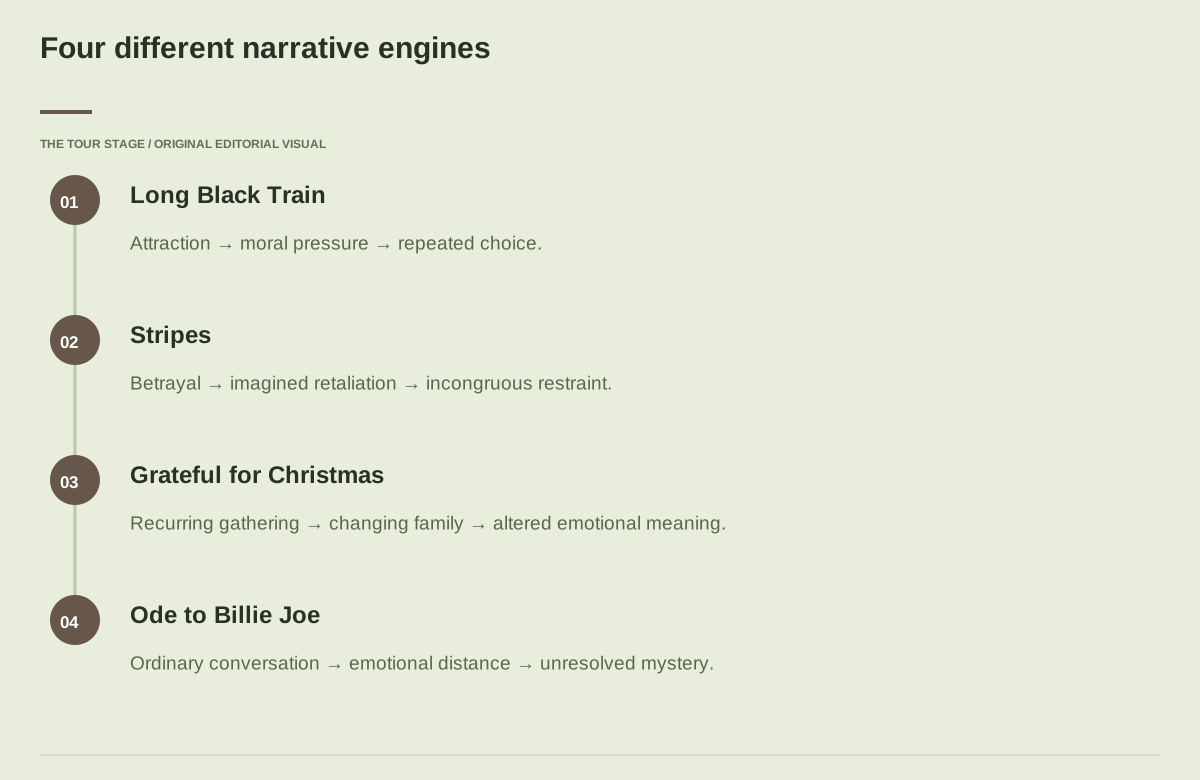
Four different narrative engines
- Long Black TrainAttraction → moral pressure → repeated choice.
- StripesBetrayal → imagined retaliation → incongruous restraint.
- Grateful for ChristmasRecurring gathering → changing family → altered emotional meaning.
- Ode to Billie JoeOrdinary conversation → emotional distance → unresolved mystery.
Read the visual as text
- Long Black TrainAttraction → moral pressure → repeated choice.
- StripesBetrayal → imagined retaliation → incongruous restraint.
- Grateful for ChristmasRecurring gathering → changing family → altered emotional meaning.
- Ode to Billie JoeOrdinary conversation → emotional distance → unresolved mystery.
Stripes: the reason for a decision becomes the joke
Brandy Clark’s “Stripes” offers a different kind of withheld action. The narrator imagines retaliation against an unfaithful partner, but the consequences are filtered through an incongruously practical objection. The comedy lies in the mismatch between the severity of the imagined act and the speaker’s stated reason to avoid it. Discussing that structure does not require reproducing the hook or confusing the character’s fantasy with advice.
The label-supplied recording credits name Clark, Matt Jenkins and Shane McAnally as writers, with Dave Brainard producing. Hear how the performance lets the narrator present her logic with conviction. The audience can recognise a distorted scale of priorities while enjoying the precision of the delivery. A narrator does not have to confess confusion for the song to reveal it. That gap between speaker and listener is one of the most efficient tools in character writing.2
Grateful for Christmas: repetition measures time
Hayes Carll’s “Grateful for Christmas” uses recurring family gatherings to make change audible. The official recording credit identifies Carll as writer and places the track on KMAG YOYO (& Other American Stories). Listen to what changes around the recurring occasion. The calendar provides an apparently stable frame, while the people within it age and their circumstances shift. Repetition can therefore reveal loss without requiring a new narrative device for every verse.3
This structure rewards a complete listen. An early comic detail can acquire tenderness when you remember it later; an ordinary family ritual can become a way of measuring absence. The performance’s tone need not become uniformly sombre for that change to work. Humour and grief can share the same scene. Notice how your response to the recurring idea changes even when the song remains recognisable. That is narrative development happening through context, not only through newly introduced information.
Ode to Billie Joe: an unanswered question can be the design
Bobbie Gentry’s “Ode to Billie Joe” is a valuable counterexample to the assumption that a story song must explain its mystery. The Smithsonian’s discussion highlights the family’s casual conversation around tragic news and Gentry’s resistance to making the unexplained object the whole point. The Library of Congress registry essay likewise places the mystery within a wider narrative. These sources support attention to the song’s controlled gaps, rather than a claim to solve them.45
Listen for the distance between what is said at the table and what the narrator’s attention suggests. Domestic detail does not merely decorate the story; it exposes the mismatch between routine and emotional consequence. A definitive answer might reduce that tension. The ending can leave the listener with a relationship to the scene instead of a solution. Treating ambiguity as a deliberate artistic resource makes room for stories whose force depends on what remains unspoken.
The band can control the reader’s equivalent of pace
A prose story can slow down with description or jump forward with a new paragraph. A recording does some of that work through rhythm, instrumental texture and the length of a pause. A repeated accompaniment can make events feel inescapable. A sudden withdrawal can leave a sentence exposed. An instrumental break can give the listener time to absorb information before the next verse changes its meaning.
Do not assume that a musical change corresponds to a plot point in a simple one-to-one code. The arrangement may remain steady while the narrator’s circumstances deteriorate, making the contrast itself expressive. Compare Turner’s recurring moral choice, Clark’s comic restraint and Carll’s annual frame. Each uses recurrence differently. Our album-sequencing feature expands the question of pacing across a longer form, while the ballad guide considers phrasing within a line.
Draw an arc without flattening the song
For a useful story map, label an opening situation, a source of pressure, a change in understanding and an ending condition. Do not force every song to include a conventional resolution. “The choice remains,” “the speaker talks herself out of action,” and “the mystery stays open” are meaningful outcomes. The visual below uses those descriptions rather than invented dramatic scores or copied lyrics.
Then listen again without your notes. A diagram should sharpen attention, not replace the pleasure of the performance. Follow the first deep-listen albums toward more character writing, and compare Turner with Clark or Carll for another kind of narrative voice. The best story-song analysis can explain why an apparently simple recording keeps changing in your mind after the last line has ended.
Sources & further reading
- Belmont: Turner campus conversationTurner’s first-person train-metaphor explanation and songwriting context.
- Warner-supplied Stripes recordingWriter and producer credits; recording as primary text.
- UMG-supplied Grateful for ChristmasCarll writing credit and recording as primary text.
- Smithsonian: Ode to Billie JoeNarrative ambiguity and Gentry’s explanation.
- Library of Congress registry essay1967 recording and narrative context.