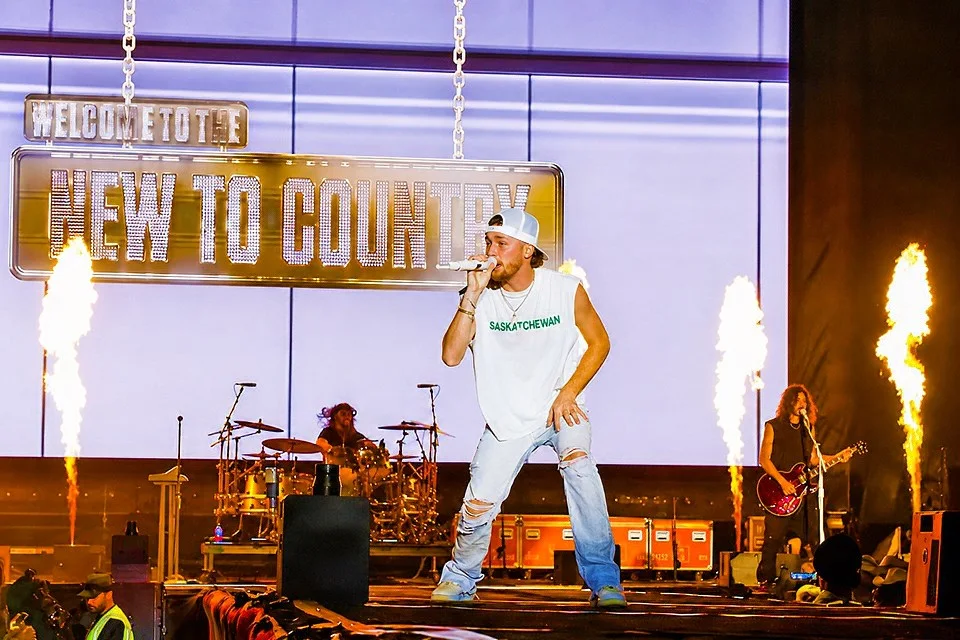
Compare the locations actually listed now
At the November 8, 2026 research check, the organiser’s main navigation lists Arizona, Saskatchewan and Wisconsin. Their location pages identify Florence, Craven and Twin Lakes respectively. This guide compares that current set rather than extending an older list of Country Thunder destinations into a new year.123
Start with three independent candidate trips. Each needs its own travel dates, accommodation, local transport and ticket basket. A familiar brand logo does not establish identical camping dimensions, shuttle arrangements, child admission or premium benefits. Even a genuine festival screenshot can be the wrong location. Keep the state or province in every saved filename and group message so that a helpful shared link does not quietly replace the information for your chosen destination.
Arizona: solve the Florence approach
The Arizona edition is advertised for April 8–11, 2027. Its current information page names AZ Talio Ranch at 20585 East Water Way in Florence and directs visitors to edition-specific parking and a partner shuttle. It also warns that onsite parking inventory is limited. Use that current address and approach information instead of an older venue name attached to a search result.14
Compare an onsite stay with a hotel only after tracing the complete daily journey. If considering a partner shuttle, verify its actual pickup, departure and return terms for the edition. A room convenient to an airport may be inconvenient for a festival connection. If driving, decide who drives after the show and what happens if your group separates. Build a vehicle plan that works for all four days rather than assuming the first ride into the event also solves every journey home.
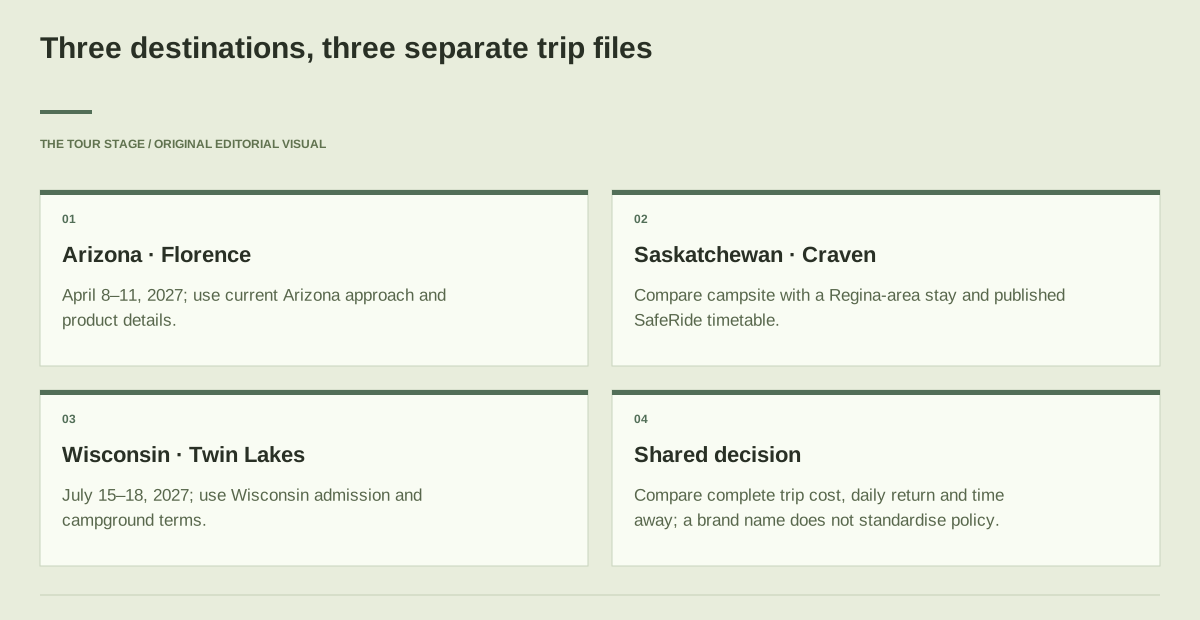
Three destinations, three separate trip files
- Arizona · FlorenceApril 8–11, 2027; use current Arizona approach and product details.
- Saskatchewan · CravenCompare campsite with a Regina-area stay and published SafeRide timetable.
- Wisconsin · Twin LakesJuly 15–18, 2027; use Wisconsin admission and campground terms.
- Shared decisionCompare complete trip cost, daily return and time away; a brand name does not standardise policy.
Read the visual as text
- Arizona · FlorenceApril 8–11, 2027; use current Arizona approach and product details.
- Saskatchewan · CravenCompare campsite with a Regina-area stay and published SafeRide timetable.
- Wisconsin · Twin LakesJuly 15–18, 2027; use Wisconsin admission and campground terms.
- Shared decisionCompare complete trip cost, daily return and time away; a brand name does not standardise policy.
Saskatchewan: distinguish Craven from a Regina stay
The Saskatchewan location is Craven, north of Regina. The organiser’s information page describes a SafeRide shuttle from Regina and Moose Jaw, with schedule details to follow. The city where you sleep and the festival location are therefore separate pieces of the plan; a hotel booking does not establish a shuttle entitlement or a particular return time.25
For a Canadian trip, write the budget in the currency you will actually pay and keep foreign-currency travel expenses separate until you choose an exchange assumption. Do not compare a Canadian headline amount directly with a US figure. Check the precise accommodation address against the published pickup once the timetable is available. If several friends are travelling from different places, decide whether meeting in Regina simplifies the trip or merely adds another transfer. Work from the final music night back to your lodging, then repeat the exercise for each day.
Wisconsin: keep Twin Lakes details together
The Wisconsin page specifies Twin Lakes and July 15–18, 2027. It has its own tickets-and-camping link, information page and hotel-package route. Use that complete Wisconsin path when assembling the booking rather than choosing a camping answer from another location because the product name sounds similar.3
For a regional road trip, compare the full return journey with the time you want to remain at the event. Include packing and checkout as well as driving. For a flight-based trip, assess the airport connection and rental arrangement as a separate decision. A destination can be geographically closer yet less convenient if the final transport leg is awkward. The useful question is how much travel, sleep disruption and equipment handling the party is willing to accept for the performances it most wants to hear.
Compare camping by specification, never by brand
Open the chosen location’s actual campsite product and record its space, vehicle allowance, people allowance, power and entry conditions. Put concert admission on a separate line until the product explicitly states it is included. Check whether each camper requires another access entitlement. The location pages direct to separate ticket-and-camping inventories, which is the right place to establish those conditions.123
Draw your physical setup rather than relying on the vehicle’s marketing size. A tow vehicle, trailer, awning and tent can occupy far more space than the sleeping unit alone. If equipment is rented, ensure the booking fits the largest rig you may receive. Check which party member holds the booking and what information the driver needs at entry. Any answer copied from a different Country Thunder stop should be treated as a question to ask, not a settled rule.
Use a comparison table with honest unknowns
Place the three destinations in rows and give each the same columns: confirmed music priorities, travel days, total quoted cost, sleeping arrangement and nightly return. Write “to verify” only for the exact field that needs another answer. This is more helpful than labelling the whole destination uncertain or filling the gap with an assumption from another festival. A missing shuttle timetable, for example, affects transport planning; it does not erase a verified event date.
Put the strongest reasons for each location in plain language. One may have the easiest drive, another the most appealing daily bill and another the accommodation arrangement your group prefers. Resist collapsing everything into a single artificial score. The tradeoffs are personal, and an apparently precise ranking would conceal how much importance your party places on sleep, music and time away. Discuss the two or three columns that actually decide the trip.
Once a location is chosen, preserve the comparison as a decision record and stop treating the other editions as a policy reference. Keep a concise final purchase checklist for that one state or province. Verify the currency, festival year, number of days, campsite and individual admission requirements on the actual basket before payment. This turns broad comparison into a specific, coherent booking. It also gives late-joining friends a clear explanation of what has been chosen and which separate items they still need, without sending them through a confusing collection of destination tabs.
Compare the music on the actual daily bill
Begin with each edition’s official lineup rather than an undated poster circulating across fan groups. A shared headliner does not mean the support bill or running order is shared. If one artist is the reason for a long trip, match their date and location to your travel window before buying the rest of the journey.
For a broader preparation route, try Tim Hicks, Dallas Smith and Brantley Gilbert as examples of country music’s varied live-energy approaches. Those links offer listening context, not a claim about a particular 2027 booking. Compare what draws you to each: vocal character, guitar weight, a singalong chorus or rhythmic momentum. Then use the artist-discovery guide to investigate unfamiliar names on the confirmed bill you choose.
Handle inconsistent date labels carefully
Some detailed information pages combine 2027 headings with older renewal references. A renewal date concerns the purchase process and can refer to an earlier season; it should not be promoted into the next event’s performance dates. Use the location’s edition announcement for the festival dates and the matching product terms for the purchase.45
When a detail affects a non-refundable booking, send the organiser a focused question containing the location, year and product. “Can our thirty-eight-foot total setup use this site?” is much easier to answer than “Is camping okay?” Keep the reply beside the reservation. This approach avoids both excessive uncertainty and false precision: you can plan the large pieces now while resolving the exact condition that matters to your group.
Choose with a complete-trip comparison
Make a row for each destination with admission per person, shared accommodation, transport, food, equipment and extra nights. Use your quoted prices in the festival dashboard; it is a planning estimate, not a live price service. Keep deposits in the cash-needed-upfront total even when they may later be refunded.
Next compare the nonfinancial demands: days away, hours in transit, daily return difficulty and how much camping work someone must do. The cheapest ticket is rarely the entire decision. A shorter, simpler trip may leave more energy for discovery, while a longer trip may be worthwhile for a distinctive bill. Once you choose, close the other location tabs and build one coherent itinerary in the weekend planner. Country Thunder becomes easier to navigate when the brand introduces the options and the chosen location supplies the rules.
Sources & further reading
- Country Thunder ArizonaFlorence edition, April 8–11, 2027 and Arizona-specific booking navigation.
- Country Thunder SaskatchewanCraven location and separate Saskatchewan ticket/camping navigation.
- Country Thunder WisconsinTwin Lakes; July 15–18, 2027; separate Wisconsin products.
- Country Thunder Arizona informationCurrent AZ Talio Ranch address, limited parking and partner shuttle; mixed older renewal wording.
- Country Thunder Saskatchewan informationCraven/Regina orientation; SafeRide service description with timetable forthcoming; mixed renewal wording.