Start in Stillwater, not with a guitar setting
Red Dirt is an unusually place-conscious musical term. Stillwater’s official visitor organisation identifies The Farm, a gathering place west of town, as central to a network including Bob Childers, Tom Skinner and the Red Dirt Rangers. These connections matter because a scene can transmit songs, encouragement and opportunities without producing one standard arrangement. It is better to begin with those relationships than a rule about how much distortion a band should use.1
The community’s history is not reducible to a university town suddenly discovering country music. Musicians brought different experiences and influences into shared spaces; younger players learned by being around older writers and performers. That is why Red Dirt can contain folk-like economy, a country dance pulse and rock-band force. The term points to a history of exchange as well as a recognisable attitude toward songs. A recording need not contain every one of those elements to participate.
The Farm as a model of musical exchange
A gathering place is important because it changes what can happen between formal gigs. Someone can try a song before it is polished, hear another writer’s approach or find a musician who can make an arrangement move. Those possibilities help explain the value of the Farm without turning it into a romantic claim that every great record was written there. The documented connection is the community around the place; individual song origins require their own evidence.
Listen with that distinction in mind. A recording may sound solitary while belonging to an intensely social network. Conversely, a large band can make room for a personal, unguarded lyric. Avoid assuming that rough edges prove an informal recording process, or that slicker production breaks the connection to the scene. As with Americana, the social label and the audible arrangement answer related but different questions.
Oklahoma anchors, not a complete family tree
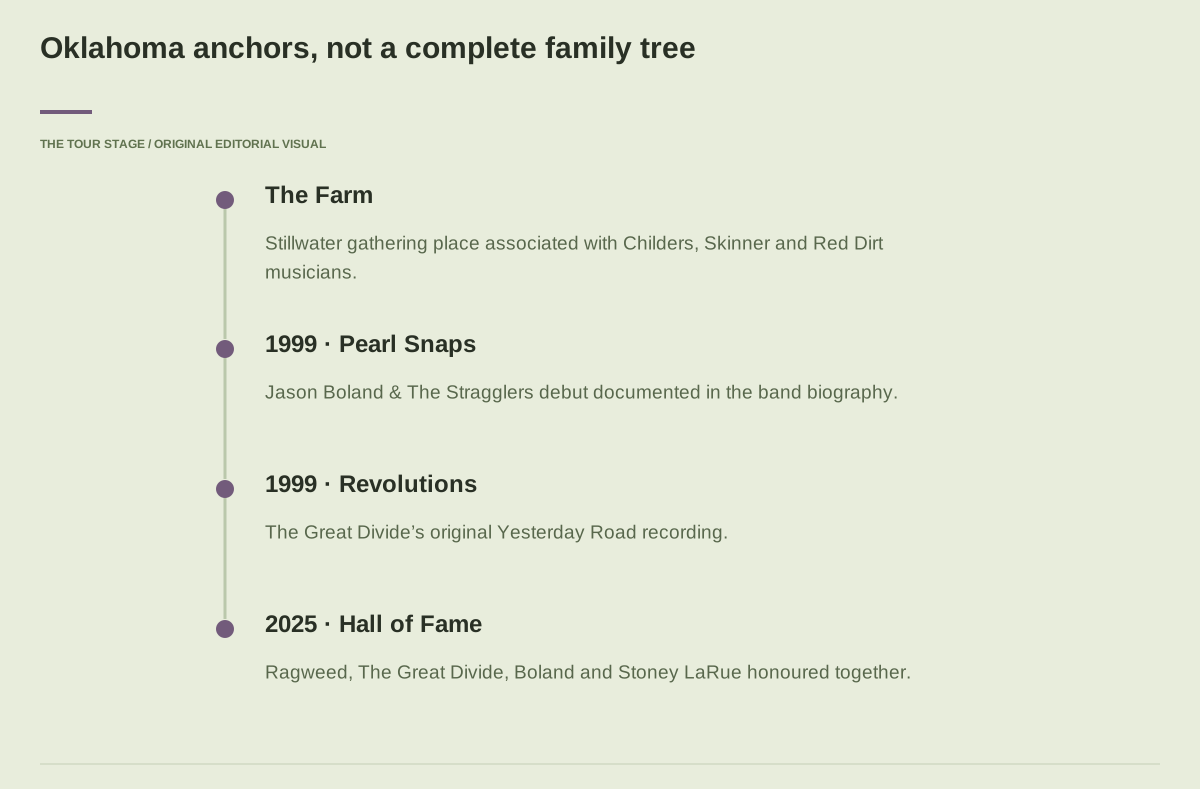
- The FarmStillwater gathering place associated with Childers, Skinner and Red Dirt musicians.
- 1999 · Pearl SnapsJason Boland & The Stragglers debut documented in the band biography.
- 1999 · RevolutionsThe Great Divide’s original Yesterday Road recording.
- 2025 · Hall of FameRagweed, The Great Divide, Boland and Stoney LaRue honoured together.
Read the visual as text
- The FarmStillwater gathering place associated with Childers, Skinner and Red Dirt musicians.
- 1999 · Pearl SnapsJason Boland & The Stragglers debut documented in the band biography.
- 1999 · RevolutionsThe Great Divide’s original Yesterday Road recording.
- 2025 · Hall of FameRagweed, The Great Divide, Boland and Stoney LaRue honoured together.
Jason Boland: the country pulse remains visible
Jason Boland & The Stragglers provide a clear first route through Pearl Snaps. The official biography dates that debut to 1999 and places the band’s formation in Stillwater while Boland attended Oklahoma State. The official anniversary listing includes “Somewhere Down in Texas,” “Proud Souls,” “Telephone Romeo,” and “If I Ever Get Back to Oklahoma.” Those titles also reveal why state lines are an inadequate way to sort every song.23
On a first listen, follow the relationship between the lead vocal and the danceable pulse. On a second, concentrate on the instrumental answers. The band can project forward motion while leaving the singer room to sound reflective or unsettled. This is a useful corrective to a Red Dirt playlist that contains only the loudest guitar tracks. Country phrasing is part of the scene’s working vocabulary, rather than an earlier stage that bands must outgrow.
The Great Divide: hear the band and the song together
The Great Divide offer another entry through “Yesterday Road.” A 2025 release statement issued for the band identifies the original recording on Revolutions in 1999, with Lloyd Maines producing, and describes a new live recording from the Boys From Oklahoma concerts. Treat the two recordings as distinct documents: one fixes a studio arrangement, while the other places the song inside a later public reunion with its audience.4
Listen for what survives the change of context. The melodic shape and narrative premise can remain familiar even when the weight of a chorus changes. Then ask what is specific to the live performance: an extended ending, vocal emphasis or audible response from the room. Do not assume that every sound on a live album is untouched, or that the studio recording is less representative. They reveal different ways a band presents the same piece of writing.
Cross Canadian Ragweed: volume does not erase the roots
Cross Canadian Ragweed demonstrate why Red Dirt is not a synonym for a gentle acoustic sound. Start with the contrast between a restrained verse and a forceful band entrance, then track how the vocal stays legible within the guitars. A strong rock presence can coexist with an attention to place, character and emotional directness. The interesting question is how the band balances them in a particular performance.
The band’s official site documents the live release Live & Loud at Boone Pickens Stadium. That gives a concrete later listening destination alongside the earlier catalogue, rather than requiring a claim that the scene ended at one historical peak. The Oklahoma Music Hall of Fame’s account of its 2025 inductions places Ragweed, The Great Divide, Boland and Stoney LaRue together in a documented act of public recognition.56
Where Oklahoma and Texas connect
Red Dirt artists have long found listeners beyond Oklahoma, and songs, bills and friendships cross the Texas border. That does not make “Red Dirt” and “Texas country” historically identical. One term points especially to the Stillwater community; the other can describe a wider regional network of artists, dance halls, radio and audiences. Use the more specific term when the historical connection matters, and allow overlap when discussing a shared bill or listening habit.
Our Texas-country explainer follows those venues and circulation routes. Here, keep an Oklahoma thread in view by moving between Boland, the Great Divide and Ragweed. Notice that their differences are part of the evidence. A scene strong enough to connect those approaches is more interesting than a label applied only to bands that sound alike. Similarity of accent, clothing or album artwork is too weak a test on its own.
A three-record listening exercise
Give each of the three acts an uninterrupted album side or equivalent run of tracks. Write one note about the song, one about the band, and one about the connection to the scene established by a source. This keeps musical judgment separate from historical verification. It also prevents a common shortcut: calling everything “gritty” and learning nothing about how the records actually work. Compare the point where each singer turns a private line into something a room could share.
The timeline below selects documented anchors, not a claim to list every founder or turning point. Follow it outward to Bob Childers, Tom Skinner and the Red Dirt Rangers when you want the earlier songwriting context, and to live country albums when you want to hear the communal dimension. Red Dirt becomes clearest when recordings and relationships stay in view together. Its identity is not weakened by musical variety; that variety helps explain what the community made possible.
Sources & further reading
- Visit Stillwater: Red Dirt musicThe Farm and Stillwater artist community.
- Jason Boland official biographyStillwater formation and 1999 Pearl Snaps.
- Official Pearl Snaps anniversary listingVerified album tracks.
- The Great Divide release statementBand-issued statement: original and live Yesterday Road recordings.
- Cross Canadian Ragweed official siteLive & Loud at Boone Pickens Stadium release.
- Oklahoma Music Hall of Fame2025 recognition of four Red Dirt acts.