
Make three lists before putting anything in a bag
Create an arena list, an overnight list and a camping-only list. The arena list should fit the organiser’s bag policy and cover the hours you expect to spend inside. Overnight belongings can include spare clothing, washing supplies and charging equipment that never need to pass the concert entrance. Camping adds shelter, bedding and any permitted equipment for the pitch. Keeping these lists separate prevents a perfectly sensible campsite purchase becoming a gate problem.
Start a fourth small list labelled “check.” Put uncertain items there instead of packing on the strength of somebody else’s festival photograph. Chairs, umbrellas, refill bottles, food, aerosols and camera equipment vary between events. A trip to see Megan Moroney, Ella Langley or HARDY needs the rules of the specific site, not a universal country-festival accessory collection.
Entry essentials deserve their own pocket
Keep your ticket or wristband instructions, relevant identification and a means of payment together. Read whether the organiser requires activation, original identification or the lead purchaser to collect credentials. Save permitted offline copies of confirmations and write down the accommodation address. Do not place essential admission details in a bag that will be left with another member of the group. A dead battery should be an inconvenience you anticipated, not the moment you first discover how collection works.
Check the exact allowed dimensions before buying a bag. Stagecoach’s current general-information page and High Water’s help centre use their own item and bag policies; neither should be treated as a template for another event.12 Measure the packed bag, including protruding pockets. Review any separate policy for a stadium or indoor venue included in the same weekend.
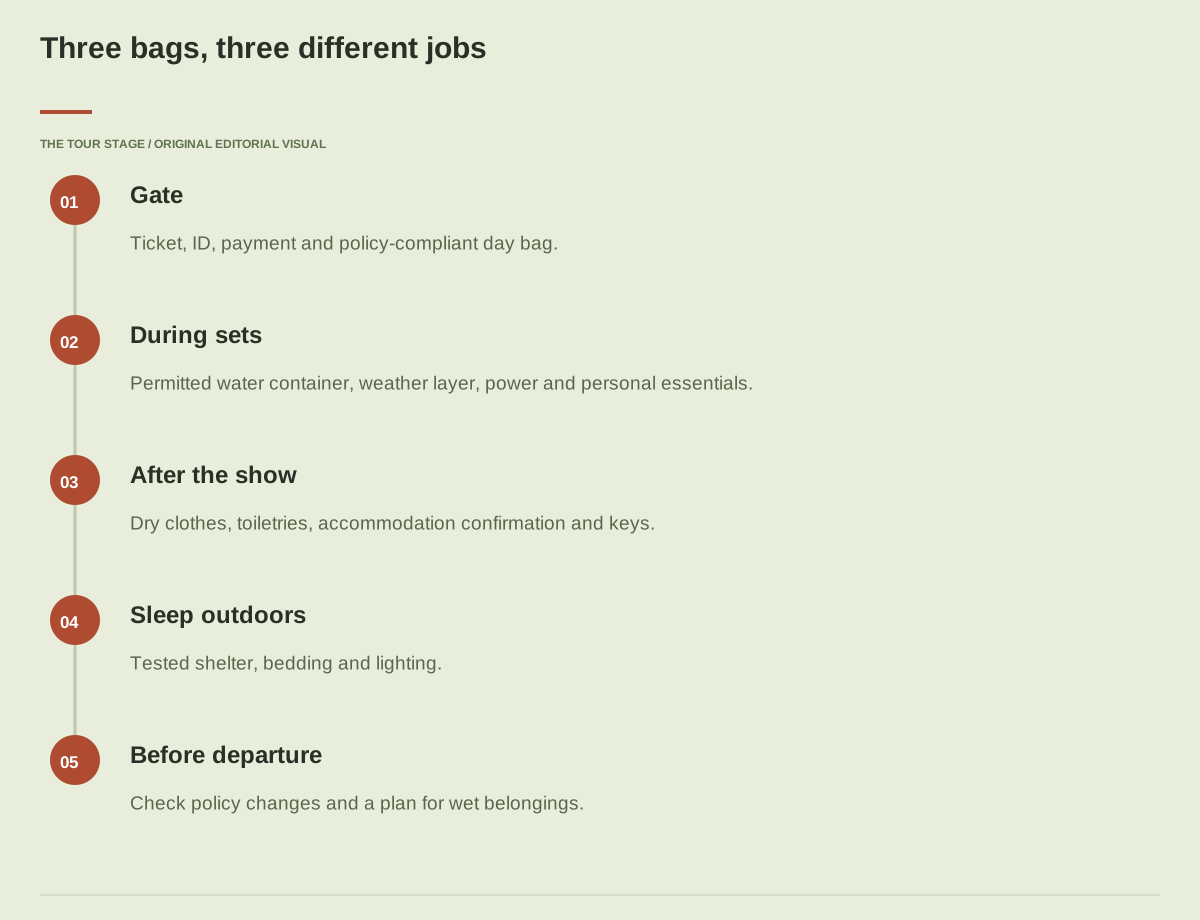
Three bags, three different jobs
- Arena · GateTicket, ID, payment and policy-compliant day bag.
- Arena · During setsPermitted water container, weather layer, power and personal essentials.
- Overnight · After the showDry clothes, toiletries, accommodation confirmation and keys.
- Camping only · Sleep outdoorsTested shelter, bedding and lighting.
- All trips · Before departureCheck policy changes and a plan for wet belongings.
Read the visual as text
- Arena · GateTicket, ID, payment and policy-compliant day bag.
- Arena · During setsPermitted water container, weather layer, power and personal essentials.
- Overnight · After the showDry clothes, toiletries, accommodation confirmation and keys.
- Camping only · Sleep outdoorsTested shelter, bedding and lighting.
- All trips · Before departureCheck policy changes and a plan for wet belongings.
Pack clothing for a day that changes
Build around comfortable footwear you have already worn, a weather-appropriate base layer and a compact extra layer. Check the local forecast near departure, then consider the time you will spend exposed after sunset. Rain protection is useful only if it is permitted, accessible and suitable for walking. Keep one dry change at your accommodation, packed so it remains dry if the outer bag gets wet.
Do not assume all outdoor country festivals share the same climate. MerleFest’s organiser advises preparation for variable April conditions.3 That supports a layered approach to its foothills setting, not a prediction for a desert event. If your outfit includes boots, test them on a long walk rather than judging comfort while standing at home. Bring the clothes that let you enjoy several hours of music without needing to protect the clothes themselves.
Use the water and sun policies together
Identify refill points on the official site map and check the permitted bottle type, capacity and entry condition. Pack the bottle empty when the policy requires it. Then think about how you will keep sunscreen, a hat and other weather essentials reachable without emptying the whole bag. A bulky item that blocks your route to water or tickets is less useful than it appeared on the packing table.
High Water’s current permitted-item page allows empty reusable bottles and portable battery packs, and restricts sunscreen to non-aerosol containers within a stated size.2 Read the page directly for its exact limits and edition context; it was checked on 8 November 2026. This is a policy example rather than permission at another festival. If you need a medically necessary item that seems to conflict with a general restriction, ask the organiser about its procedure before travelling.
Keep personal essentials usable and discreet
Take any required medication in the form and packaging specified by the event. Check who handles exceptions, whether a separate entrance is used and whether supplies can be brought for the full weekend or only one day. Keep the organiser’s written response with your documents. Pack small personal essentials such as ear protection, tissues and hygiene supplies according to your needs. Avoid transferring something important into an unlabelled container merely to save a little space.
A phone battery pack can protect access to tickets and communication, but cables are easy to forget. Charge devices before leaving and test the combination you intend to carry. If the group separates, agree a meeting place and time that works without a phone. The group-planning guide explains that system. A packing list supports the plan; it cannot replace a clear decision about what to do when reception fails.
Give the campsite a separate equipment check
For a tent, check the shelter, poles, pegs, ground protection where appropriate and a sleeping system suitable for expected conditions. Assemble the tent beforehand. Add lighting, clothing storage and rubbish bags, then identify how everything will be transported to the pitch. If two people share equipment, name the person carrying each indispensable component. “Someone has the tent” is insufficient when the poles are in a different car arriving several hours later.
Check cooking and fuel rules immediately before departure, including temporary restrictions. The Long Road’s dated August 2026 festival guide prohibited open flames and charcoal barbecues under that edition’s dry-weather precautions, while describing conditions for permitted gas stoves.4 A previous year’s camping habit is therefore poor evidence for your next trip. The accommodation comparison helps decide whether carrying and maintaining this equipment fits the weekend you want.
Use a practical final checklist
- Admission: correct ticket, collection instructions, required ID and payment method.
- Day bag: permitted dimensions, refill bottle if allowed, weather layer and personal essentials.
- Power: charged phone, working cable and permitted battery pack.
- Overnight: dry clothing, toiletries, booking details and access to keys.
- Camping only: tested shelter, bedding, lighting, permitted cooking equipment and a carry plan.
- Departure: return tickets, luggage arrangement and bags for wet or muddy belongings.
Mark each entry “packed,” “shared,” “not needed” or “awaiting policy.” Put the organiser’s name and the date checked at the top. That last status matters: an unresolved item should trigger a decision, not silently enter the bag. If something optional creates uncertainty, leave it at your accommodation until its use is confirmed. Keep necessary exceptions documented.
Do one rehearsal with the packed bag
Wear the bag and shoes for a short walk, retrieve your ticket and bottle, then put on the rain layer. This simple rehearsal reveals awkward packing much faster than another online checklist. Remove duplicates that add weight without solving a real problem. Check whether anything leaks, whether your charging cable reaches comfortably and whether the bag still closes within the allowed size.
Make a final policy check on the organiser’s official channels before departure, especially for weather-related changes. Save the site map and place essentials where they stay reachable during travel. The goal is a bag you can carry comfortably and use without spreading belongings across a busy entrance. Once it works, stop adding speculative extras and use the remaining preparation time to explore the unfamiliar names on the lineup.
Sources & further reading
- Stagecoach general informationCurrent 2027 sales-cycle entrance and allowed-item rules; checked 8 November 2026.
- High Water permitted and prohibited itemsCurrent bottle, battery, sunscreen, medication and bag policies; page checked 8 November 2026, no edition is asserted.
- MerleFest festival informationOrganiser advises layers and rain preparation for variable April weather.
- The Long Road 2026 festival guideDated 2026 guide describes dry-weather fire restrictions and controlled gas-stove permission.