
Agree the decisions that genuinely need a group answer
Start with the edition, days, spending ceiling and accommodation style. Ask each person for one must-have performance or experience and one practical limit. Somebody may want a full headline set; somebody else may need an early return or a quiet night. Recording those priorities early prevents the loudest preference becoming the group’s supposed consensus. Choose a booking deadline only after everyone has the information needed to decide.
A group brought together by LOCASH, Parmalee or Niko Moon will still have different listening habits. Use those artists as discussion starters, not an assumption that every person wants the same timetable. The lineup-reading guide offers a quick way to share a few listening links. Decide what you will do together and what can remain optional.
Give every booking a named owner
Assign one person to each reservation: admission, accommodation, transport and shared equipment. The owner checks the exact product, records its conditions and tells the group when it is confirmed. This is a practical responsibility, not authority to spend beyond the agreed amount. Keep the booking reference, purchaser name, payment deadline and access instructions in the shared plan. Every traveller should have the information they need if the lead booker is delayed.
The Long Road’s dated 2026 festival guide said e-tickets would be sent to the lead booker.1 That illustrates why a confirmation in one inbox is not the same as every person being ready to enter. Read your own ticket provider’s transfer and collection rules. Do not circulate a single barcode as if it creates multiple admissions, and do not assume somebody can collect a credential on your behalf without checking.
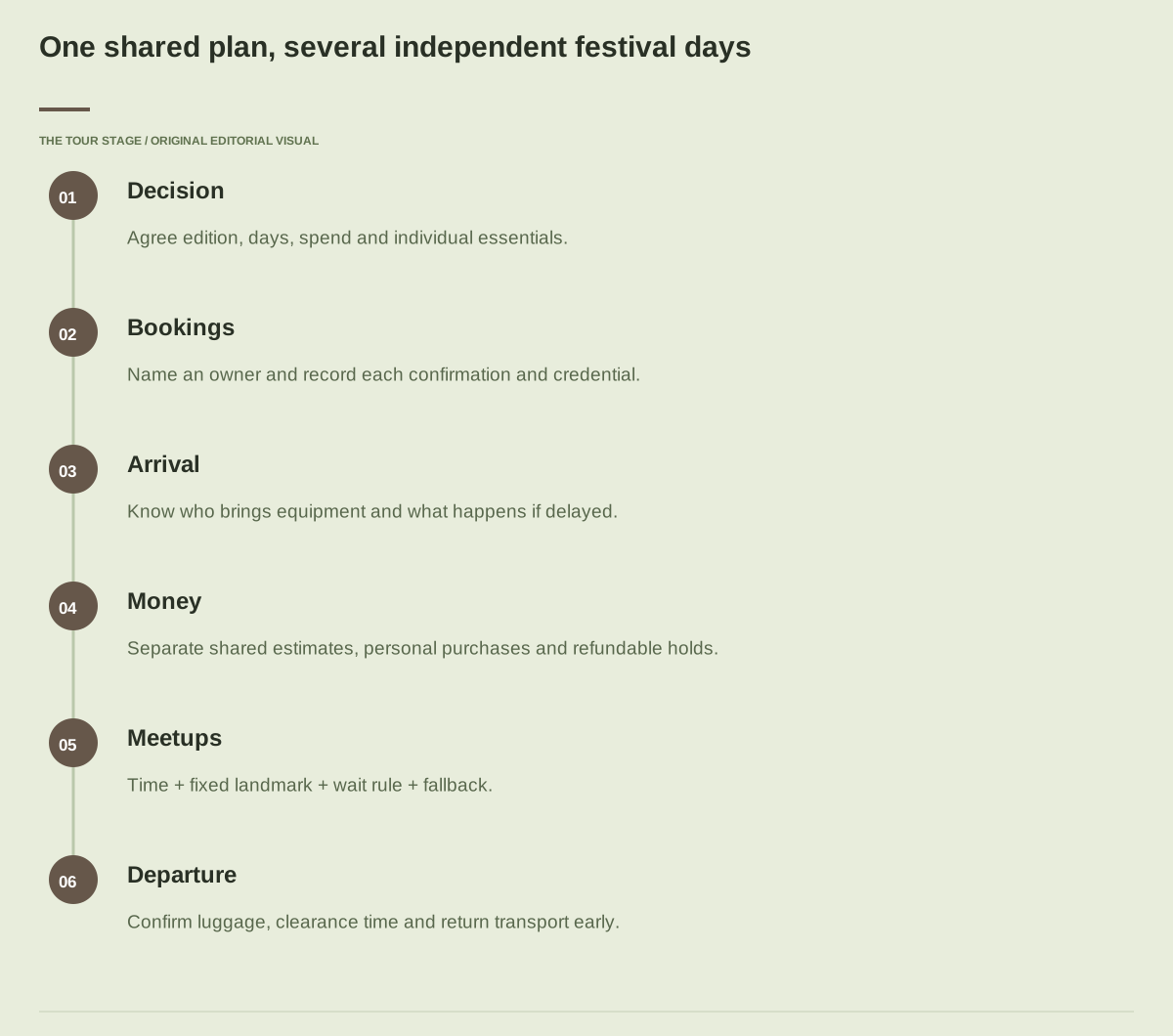
One shared plan, several independent festival days
- DecisionAgree edition, days, spend and individual essentials.
- BookingsName an owner and record each confirmation and credential.
- ArrivalKnow who brings equipment and what happens if delayed.
- MoneySeparate shared estimates, personal purchases and refundable holds.
- MeetupsTime + fixed landmark + wait rule + fallback.
- DepartureConfirm luggage, clearance time and return transport early.
Read the visual as text
- DecisionAgree edition, days, spend and individual essentials.
- BookingsName an owner and record each confirmation and credential.
- ArrivalKnow who brings equipment and what happens if delayed.
- MoneySeparate shared estimates, personal purchases and refundable holds.
- MeetupsTime + fixed landmark + wait rule + fallback.
- DepartureConfirm luggage, clearance time and return transport early.
Check that tickets and accommodation work together
Make a small table with a row for each person and columns for festival admission, overnight access, vehicle or parking arrangements and arrival day. Mark products confirmed only when the reservation actually covers that traveller. Someone joining a campsite late may need a different arrival procedure; someone staying in a hotel may not have permission to visit the camping area. A group booking can contain several separate entitlements.
Stagecoach’s Resort page requires appropriate Resort and Festival credentials and sets category-specific campsite arrangements.2 Treat it as an example of why “we have a campsite” is incomplete. Use the organiser’s current edition and chosen category to check your group’s actual permissions. The camping-versus-hotel comparison can help a mixed group decide whether shared accommodation is practical or merely assumed.
Make arrival a sequence with a fallback
Record where each traveller arrives, the intended time, who has the shared equipment and where everyone meets before entry if needed. Distinguish a station, unloading point, ticket collection point and campsite; they may be separate places. Decide what happens if the last car is delayed. Nobody should be stranded outside with the tent poles while the tent and tickets are inside with someone whose phone is flat.
Check campsite grouping and arrival rules rather than promising adjacent spaces. Some products allocate places; others depend on arrival or a specific group process. If camping together is essential, ask the organiser how to achieve it before purchasing. Keep the written response with the plan. Drivers and passengers should each know the approved entry route and any relevant gate window. A friend’s memory of a previous edition is useful context, but it is not the current instruction.
Share equipment by complete systems
Assign the shelter, sleeping arrangements, lighting and any permitted cooking setup as complete systems. For each one, list the small essential parts: pegs, poles, fuel where allowed, cables or a pump. Test unfamiliar equipment before the trip. If people arrive separately, make sure the group can manage until the later equipment appears. Agree who takes wet items home and how borrowed things will be returned.
The Long Road’s dated 2026 guide changed fire precautions in response to dry conditions.1 That is a reminder to check shared cooking equipment against the final organiser update. An agreed menu is not useful if the equipment cannot enter. The packing guide separates arena belongings from campsite equipment, which helps prevent one person becoming the carrier of everything simply because they own the largest bag.
Agree the money before making shared purchases
Write what the group will share and what remains personal. Include accommodation, transport, equipment and any common food purchase. State how many people are expected to contribute and what happens if somebody leaves the trip. Avoid ambiguous phrases such as “we will settle up later” when one person is about to make a substantial non-refundable booking. Everyone should understand the commitment before the purchase.
Use the festival budget calculator to create an equal-share estimate from agreed inputs. It is an estimate rather than a reimbursement ledger, and it cannot resolve unequal contributions. Keep a separate record of actual payments where necessary. Put refundable deposits in a distinct line and name the person whose card carries the hold. A shared total can look affordable while still placing too much temporary cash pressure on one traveller.
Use a meetup plan that works without messages
Choose a fixed landmark and a precise time for each important regrouping. “Near the main stage after the set” is too vague when the crowd is moving and several people finish different performances. Pick somewhere recognisable outside the busiest path, with a second location if access is closed. Give everyone a copy of the plan before they split. Agree how long to wait and what to do next.
MerleFest’s 2026 map marks named facilities as well as stages, illustrating the kind of official document from which to choose an identifiable meeting point.3 Do not assume a place will remain available in another edition. At arrival, look at your chosen landmark together and check that it does not block staff, accessible routes or emergency access. For urgent help, follow the organiser’s procedures and seek event staff instead of relying on your social meetup plan.
Leave room for independent days and a shared ending
Choose perhaps one meal and one performance to share, then let the rest of the day vary. A person who wants a full songwriter set should not have to abandon it because others prefer to explore. Tell companions when you are changing plans, and protect any shared return transport. If someone needs a rest, make it easy to step away without an elaborate negotiation or the feeling that they have spoiled the group’s afternoon.
Before the final night, confirm departure time, checkout or campsite clearance, luggage and the driver or service being used. Do this while everyone is rested enough to read the details. After the trip, settle agreed costs promptly and return equipment in the condition you would want to borrow it. A clear plan gives the weekend a dependable frame while leaving the music, conversations and discoveries free to be different for each friend.
Sources & further reading
- The Long Road 2026 festival guideDated guidance on lead-booker e-tickets and that edition’s dry-weather fire precautions.
- Stagecoach Resort informationCurrent 2027 sales-cycle credentials and category-specific camping rules; checked 8 November 2026.
- MerleFest 2026 mapDated map provides named stages and facilities; no meeting location is guaranteed for later editions.