
Start with four different questions
A national scene becomes easier to explore when individual records retain their differences. The four artists here are Canadian, but that geographical connection does not explain every sound you will hear. Use a separate question for each: how does an album hold a mood, how does a singer shape a familiar country form, how does a personal project organise reflection, and how does a compact EP build an immediate hook? Play one recording from each before deciding which catalogue to pursue. This is an editorial selection made in November 2026, not a claim about the four biggest careers or an exhaustive account of Canadian country. The broader coast-to-coast route provides additional regional context; here the purpose is a manageable session with enough contrast to make your next choice clear.
Owen Riegling: use In The Feeling as a complete setting
Big Loud’s release announcement documents Owen Riegling’s In The Feeling as a released album, with an official sequence and writing credits.1 Use the standard album as the starting edition and play its opening stretch in order. Notice how the voice and instrumental setting establish a sense of scale: does the singer seem to address one person, a room or a larger crowd? Then choose a track whose pace differs and ask which elements continue to connect it with the opening. You do not need to turn the title into an explanation of every song. Treat it as an invitation to hear a record’s atmosphere while allowing individual tracks their own scenes. If you come through an isolated single, check its place in the album rather than assuming its function from familiarity. A favourite can feel different when it arrives after the preceding song.
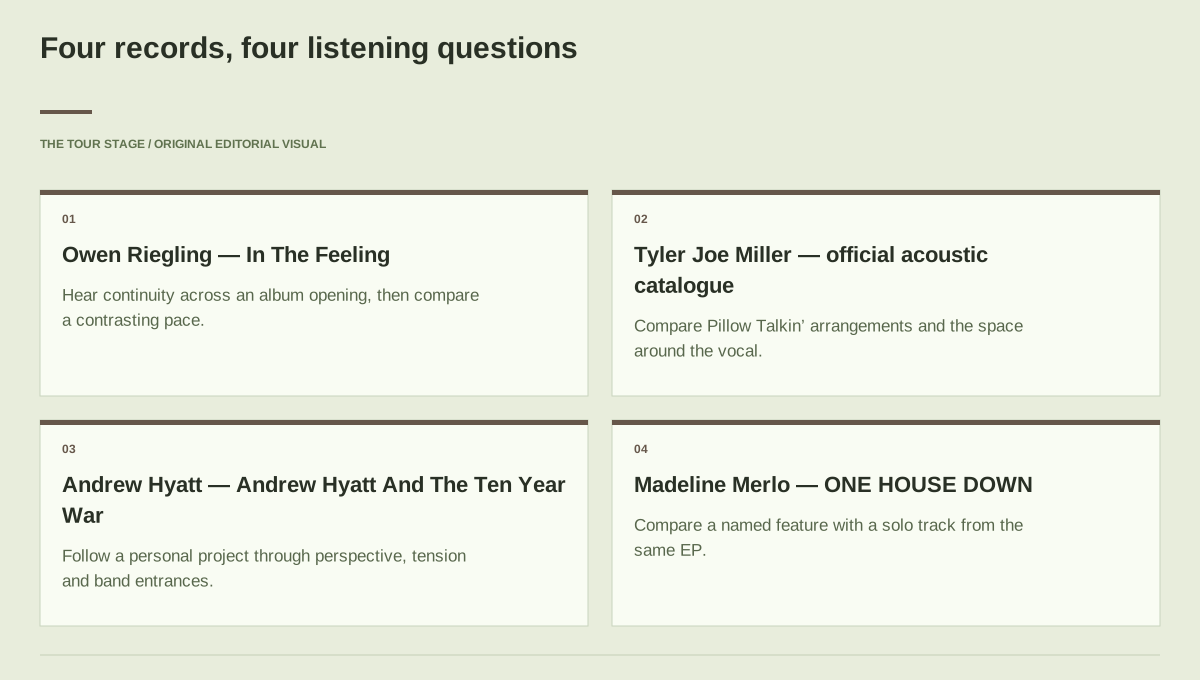
Four records, four listening questions
- Owen Riegling — In The FeelingHear continuity across an album opening, then compare a contrasting pace.
- Tyler Joe Miller — official acoustic catalogueCompare Pillow Talkin’ arrangements and the space around the vocal.
- Andrew Hyatt — Andrew Hyatt And The Ten Year WarFollow a personal project through perspective, tension and band entrances.
- Madeline Merlo — ONE HOUSE DOWNCompare a named feature with a solo track from the same EP.
Read the visual as text
- Owen Riegling — In The FeelingHear continuity across an album opening, then compare a contrasting pace.
- Tyler Joe Miller — official acoustic catalogueCompare Pillow Talkin’ arrangements and the space around the vocal.
- Andrew Hyatt — Andrew Hyatt And The Ten Year WarFollow a personal project through perspective, tension and band entrances.
- Madeline Merlo — ONE HOUSE DOWNCompare a named feature with a solo track from the same EP.
Compare the record with Bruce County material
Riegling’s official biography connects his work with the Bruce County project and his small-town background.2 Select one song from that earlier project after hearing part of In The Feeling. The useful comparison is musical rather than a verdict that the later album must represent progress. Focus on the distribution of attention between voice, guitar and rhythm. Does the arrangement make its emotional point through repetition, a lift into the chorus or a more sustained conversational delivery? Write one observation about what stays consistent and one about what changes. This lets the catalogue become more than a collection of release dates. If the local references interest you, the Ontario guide follows provincial connections without treating all Ontario artists as one style. The record itself should remain the principal evidence for what you hear.
Tyler Joe Miller: compare the band with the exposed voice
Tyler Joe Miller’s official catalogue lists Going Home, Spillin’ My Truth and the acoustic project The Band’s Packed Up, along with named acoustic and stripped versions.3 That is a useful structure for a listening session because you can choose between a fuller setting and an arrangement that directs more attention toward the vocal. Start with “Pillow Talkin’” in the official catalogue, then find the acoustic version identified there. Hear where a syllable lands in relation to the accompaniment and how the space after a phrase changes the sense of confidence or hesitation. Avoid assuming an acoustic take is automatically more truthful. It is a different arrangement with different opportunities. The contrast can reveal how an artist retains a recognisable identity while changing the amount of sound around the song. Write down which detail became easier to hear in each version.
Andrew Hyatt: follow a personal project without reading it as a diary
Andrew Hyatt’s official biography identifies Andrew Hyatt And The Ten Year War, while his label documents Four Good Years as another catalogue entry.45 Choose the newer named project as a concentrated starting point, then use Four Good Years as a comparison. Listen for the balance between a reflective vocal posture and the release offered by a hook or band entrance. Personal presentation does not require you to identify every lyric with a verified life event. The recording creates a narrator and a sequence of emotional decisions that can be heard on their own terms. Ask how the arrangement supports that perspective: by leaving room, sustaining tension or giving a chorus a larger frame. This approach respects the project’s personal emphasis without inventing biography. It also makes comparison with another songwriter more precise than simply calling both artists honest.
Madeline Merlo: hear the EP as a compact design
The official Madeline Merlo biography identifies the six-song ONE HOUSE DOWN (from the girl next door) project and “Broken Heart Thing” featuring Dustin Lynch.6 Begin with the featured track, paying attention to how two voices distribute the song’s perspective. Then choose a solo track from the EP and hear whether the production builds its central moment in the same way. A compact release can create continuity through vocal tone, recurring textures or the kinds of situations its songs frame, even when tempos vary. Listen past the chorus to the transition back into the verse: that is often where the arrangement shows how it manages energy. The feature is one entry point, not evidence that every song uses a duet format. For another way to hear shared singing, the country duets guide distinguishes dialogue, harmony and guest appearances.
Make the contrasts audible rather than competitive
After the first round, select two recordings that differ on one clear axis. Pair an acoustic Miller performance with a fuller Merlo arrangement, or an opening passage from Riegling’s album with a Hyatt song that directs attention toward a particular narrator. Keep volume comfortable and avoid letting a louder master win the comparison automatically. Your notes can be simple: the bass enters earlier, the voice sounds closer, the chorus opens more widely, or the accompaniment leaves a longer pause. These are observations that support a preference rather than numerical scores. A listener can enjoy all four approaches for different reasons. The point of the session is to expand the vocabulary of enjoyment, so that the next unfamiliar artist has more than a vague label to compete with.
Choose the next session from what held your attention
Return to the artist whose record produced the most interesting question. Hear the whole chosen project without searching for a second single first. If you preferred the acoustic comparison, follow another explicitly labelled stripped performance. If the shared vocal interested you, investigate the featured performers separately and keep their own catalogues distinct from the collaboration. If place and scene matter most, use the regional articles as a route into more names. The choose-your-sound tool offers another editorial starting point, but your actual response to a complete record should guide what follows. Four artists are enough for an attentive evening; they are a starting selection you can revisit, replace or widen as your listening becomes more specific.
Sources & further reading
- Big Loud: In The Feeling releaseReleased album, sequence and writing credits.
- Owen Riegling official siteBruce County and artist background.
- Tyler Joe Miller official catalogueGoing Home, acoustic releases and named versions.
- Andrew Hyatt official biographyAndrew Hyatt And The Ten Year War project.
- 604 Records: Andrew HyattFour Good Years catalogue context.
- Madeline Merlo official biographyONE HOUSE DOWN and featured recording.