
A province is a network, not one scene
Ontario is too large and musically varied for a single weekend route to cover honestly. The Niagara area, Bruce County, greater Toronto and the Ottawa region are separate places with different travel demands. Begin with an artist and a confirmed performance rather than assuming every festival is near Toronto. Ontario-specific connections matter here: a local upbringing, a provincial event or a working live room is more informative than the vague fact that an artist is Canadian. The national context belongs in the coast-to-coast listening route. This guide keeps its attention on three artists and the ways a listener can move between their records and Ontario programming. No artist’s presence in this selection guarantees a forthcoming appearance at a named venue.
Tim Hicks: start with the room-sized chorus
Tim Hicks is a natural entry point for listeners who want a muscular band sound and choruses that can carry outdoors. His official catalogue includes Throw Down and a continuing body of releases; choose a complete album rather than reducing the artist to a novelty or drinking-song hook. Listen for the relationship between a conversational verse and the lift into the refrain. Electric guitars can establish energy, but rhythmic space and vocal emphasis determine whether the chorus actually lands. A useful comparison is to play an official live performance after the studio version and notice what the audience supplies. A chant that feels compact on record can become the centre of a communal performance without changing the underlying song.1
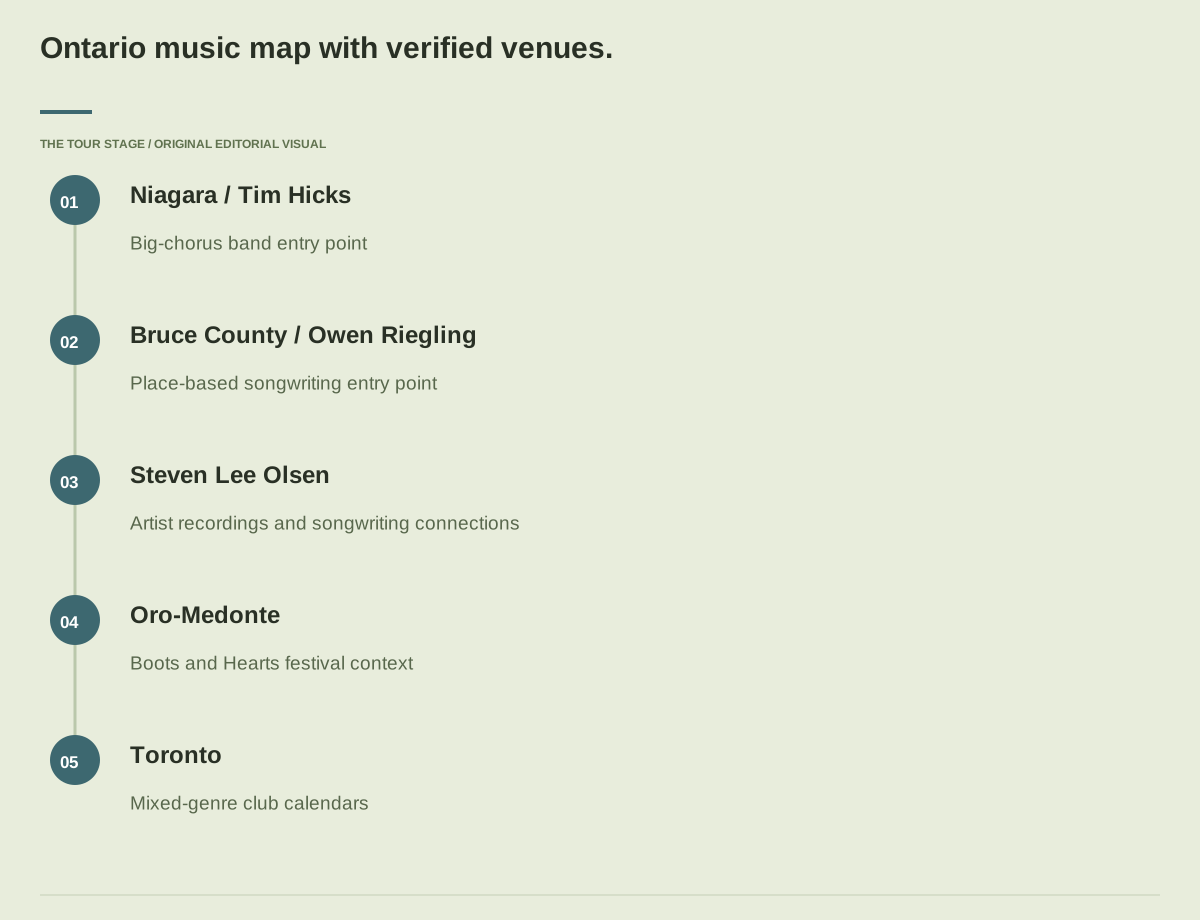
Ontario music map with verified venues.
- Niagara / Tim HicksBig-chorus band entry point
- Bruce County / Owen RieglingPlace-based songwriting entry point
- Steven Lee OlsenArtist recordings and songwriting connections
- Oro-MedonteBoots and Hearts festival context
- TorontoMixed-genre club calendars
Read the visual as text
- Niagara / Tim HicksBig-chorus band entry point
- Bruce County / Owen RieglingPlace-based songwriting entry point
- Steven Lee OlsenArtist recordings and songwriting connections
- Oro-MedonteBoots and Hearts festival context
- TorontoMixed-genre club calendars
Owen Riegling: Bruce County is a specific connection
Owen Riegling names a particular Ontario geography in Bruce County. That specificity gives a listener something firmer than a generic small-town label. Begin with “Old Dirt Roads,” then move beyond it to hear how his catalogue handles memory, departures and attachment. His later official releases can be explored separately; this route does not treat an early breakout as a summary of everything to follow. Listen for the tone of the guitar and the vocal’s mix of casual delivery and sustained emotion. A place-based song works when details serve the narrator, not merely when a familiar road appears. Readers who already know the early records can use the Canadian discovery session for another set of comparisons.2
Steven Lee Olsen: writer and recording artist
Steven Lee Olsen brings a writer-performer connection to the route. His own releases and the songs he has helped write for other singers are different parts of a career, so check the credit before assuming his voice appears on a familiar record. “Outta Yours” is an entry point into his own recordings. Listen to the smooth transition between conversational detail and a clearly shaped melodic hook. That is a different kind of immediate appeal from a hard-driving festival chorus, even when both songs sit comfortably inside contemporary country. Follow his official material to current recordings and tour information rather than using a biography’s former home or a past showcase as an up-to-date schedule. Authorship is a listening trail, not proof of a featured-vocal appearance.3
Large festivals and smaller rooms answer different questions
Boots and Hearts, held at Burl’s Creek in Oro-Medonte, and Ottawa’s Boots and Hearts Presents programming should not be casually conflated with every Ontario country event. Use each organiser’s own site for the event name, edition and location. A large festival lets you compare several acts in one setting, but a shorter set may emphasise recognisable songs. A theatre or club headline date can reveal pacing, quieter material and a more sustained relationship with the band. Neither is automatically the better introduction. Decide whether your aim is breadth or depth. The organiser’s current lineup is also the place to discover Ontario artists outside this short selection, rather than assuming only the names already familiar from radio deserve the early slot.4
Use Ontario venue calendars as discovery tools
A venue’s calendar provides evidence of a working scene, but its genre can shift from night to night. Toronto’s Horseshoe Tavern, for example, presents a broad live-music programme rather than functioning as a country-only room. Search the listed performers, open an official recording and decide whether that specific show matches your listening interest. A respected venue name is not a musical guarantee. Check the event age policy, accessible entry and seating, door time and ticket seller through the venue. For a first visit, choose one strong booking and plan transport around it. Ontario distances make the apparent efficiency of combining several towns misleading, especially after a late performance or in weather that changes the drive.5
A practical three-artist listening sequence
Play Hicks first to establish an energetic, guitar-forward reference. Follow with Riegling and attend to how a local memory can direct a song’s emotional scale. Finish with Olsen, concentrating on melodic phrasing and the mechanics of a hook. Then reverse the sequence. The quieter or smoother choice may feel different when it follows a large chorus rather than introducing the session. Record one detail about voice, rhythm and subject for each artist. This is an editorial comparison, not a measurement of who is more local or more country. If another act on an Ontario bill interests you, apply the same questions instead of trying to match them to one of the three existing boxes. A living scene will always exceed a guide’s categories.
Turn discovery into a workable outing
Save the confirmed event details, estimate the full admission cost and choose your return route before buying. Outdoor shows add weather and walking considerations; city clubs add late-night transport, parking and queue decisions. For festivals, determine whether camping, vehicle access and admission are separate purchases. Those details belong to the actual edition’s official information, so avoid recycling a past year’s instructions. Leave time to hear an opening performer whose record you have sampled in advance. Afterwards, compare one studio track with what the band changed in the room. That small follow-up connects Ontario as a destination to Ontario as an ongoing listening habit. For wider geography, continue west or east through the Canadian route rather than stretching this province into a national summary.
Sources & further reading
- Tim Hicks official websiteArtist releases and official live links.
- Owen Riegling official websiteBruce County identity and recordings.
- Steven Lee Olsen official websiteArtist catalogue and writer-performer context.
- Boots and HeartsOfficial festival location, edition and lineup.
- Horseshoe TavernCurrent mixed-genre venue programming.