
Make the event the starting point
An artist’s public image does not establish an event’s age rules, content or physical suitability. A seated afternoon show and a late standing-floor performance can make very different demands on the same child. Begin with the actual event page and think about timing, crowd movement, standing and the route home. “All ages” answers an admission question, not every family-planning question.
Artists such as Scotty McCreery, Josh Turner and High Valley can be good listening starting points for a family interested in country music. Their names here are not a guarantee that every performance has the same rules or is appropriate for every child. Preview the music and event format yourself, then decide whether the specific evening fits your family’s interests and practical needs.
Child tickets are venue-specific, even for the youngest guests
Bridgestone Arena’s current box-office information says children below their second birthday can attend concerts on a ticket holder’s lap without a separate ticket, while children aged two and older require one; the page also identifies event exceptions.1 This is a venue example to check against the actual performance, not a rule that travels with a country artist.
Gruene Hall gives a different example: children of any age need full-price admission for shows with advance tickets, and ticketed-show age exceptions may be stated.2 The contrast is the useful lesson. Ask about the exact age on the event date, whether a child receives a separate place and whether any companion or supervision rule applies. Do not copy a museum-tour discount into a concert booking; tours and performances can have separate conditions even inside the same attraction.
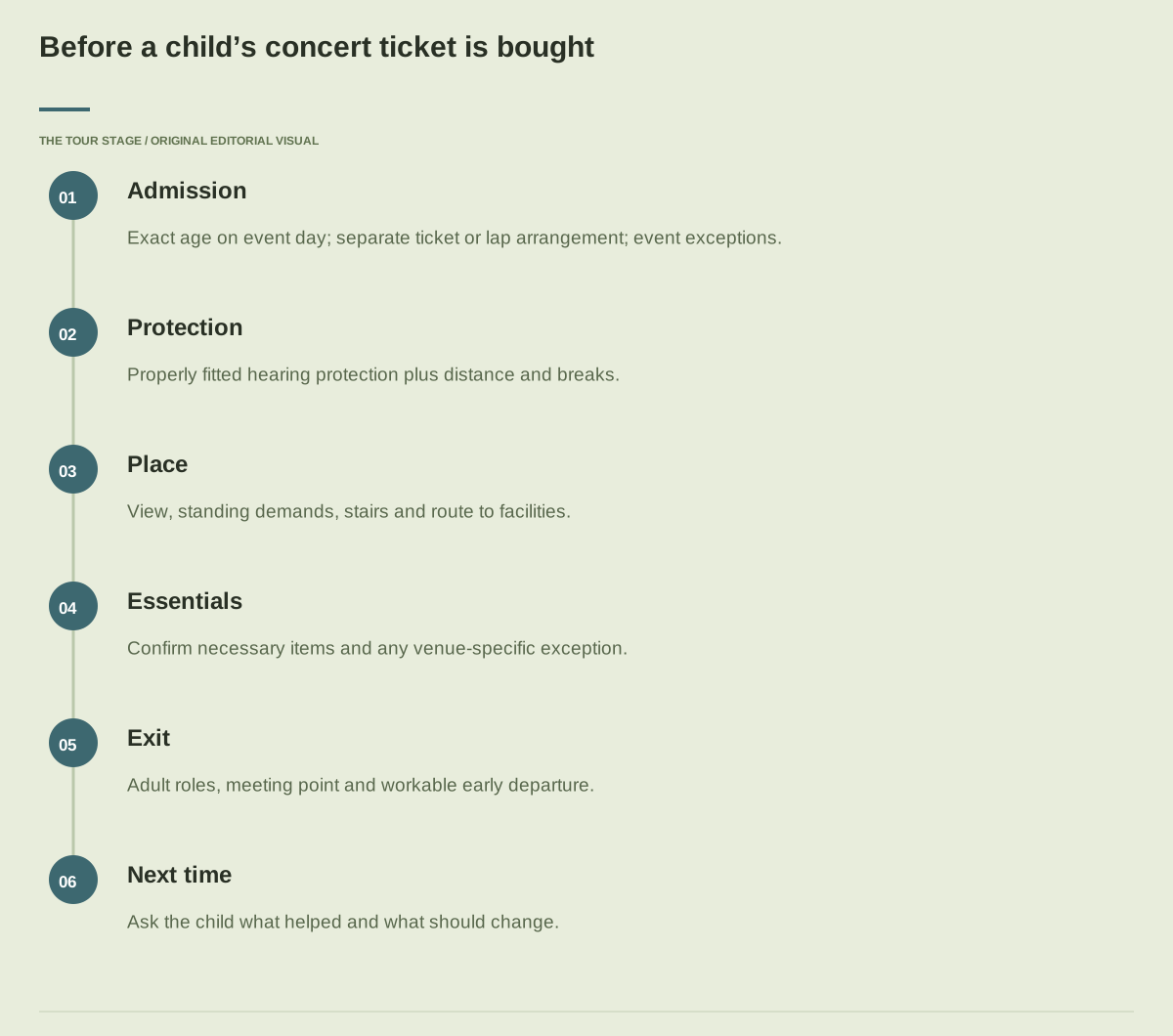
Before a child’s concert ticket is bought
- AdmissionExact age on event day; separate ticket or lap arrangement; event exceptions.
- ProtectionProperly fitted hearing protection plus distance and breaks.
- PlaceView, standing demands, stairs and route to facilities.
- EssentialsConfirm necessary items and any venue-specific exception.
- ExitAdult roles, meeting point and workable early departure.
- Next timeAsk the child what helped and what should change.
Read the visual as text
- AdmissionExact age on event day; separate ticket or lap arrangement; event exceptions.
- ProtectionProperly fitted hearing protection plus distance and breaks.
- PlaceView, standing demands, stairs and route to facilities.
- EssentialsConfirm necessary items and any venue-specific exception.
- ExitAdult roles, meeting point and workable early departure.
- Next timeAsk the child what helped and what should change.
Hearing protection needs to be ready before arrival
NIDCD identifies concerts as potentially harmful noisy activities and recommends avoiding loud sound where possible, moving away and using properly fitted hearing protection when exposure cannot be avoided. Its family guidance explains that protective earmuffs can be easier for young children to use than earplugs.3 These are protective devices, not ordinary headphones or soft winter earmuffs.
Practise wearing the chosen protection in a calm setting before the concert. Check fit and comfort, including whether glasses or clothing interfere with the seal. A product’s rating is not a guarantee of safe exposure at every event, and no protector removes all sound. Plan distance and breaks as well as the device itself. If you are unsure about protection for a particular child, obtain individual advice from an appropriate health professional before choosing a loud event.
Choose the view and exit route together
A short child may see little from a flat standing floor even when the ticket is close to the stage. A raised reserved location can offer a more predictable place, but stairs, railings and the behaviour of surrounding audiences still matter. Do not put a child on a chair or obstruct an aisle to manufacture a view. Ask the venue about an appropriate arrangement before buying.
Study the route to restrooms, guest services and an exit as part of seat selection. An easy break can matter more than a small improvement in distance from the performer. If a child needs a particular access feature, use the accessible-visit questions. The seat-selection guide explains why elevation and proximity are separate. A family ticket decision should account for the child’s actual height, stamina and comfort without assuming any single section is right for everyone.
Pack from the actual policy, not a generic family list
Make a short essentials list, then check each item against the venue’s current rules. Ask specifically about any necessary medication, feeding equipment, bag or mobility item rather than relying on a broad assumption that family supplies are exempt. If an exception is confirmed, keep the relevant instructions with the booking. The goal is a simple arrival, not the largest possible bag.
Build food and rest into the plan before entry if that helps your child, while checking whether leaving later would prevent re-entry. Choose clothes and shoes for the actual weather, walking and waiting involved. A concert outfit matters less than a child who can move comfortably and tolerate the evening’s transitions. Keep the adult’s essentials accessible too: tickets, payment, charged phone and transport information. The family plan works only if the person organising it can find the things needed at each stage.
Agree on what happens if you need to leave
Decide in advance that leaving early is an available outcome. Set a simple check-in method the child understands and respond to discomfort before it becomes overwhelming. If more than one adult attends, decide who goes with the child and how the remaining party will reconnect. Do not make that decision for the first time in a loud concourse.
Choose a meeting point and identify venue staff who can help. Give older children clear instructions for seeking staff assistance if separated, suited to their age and the venue. Avoid making a phone the only solution. A younger child may not have one, and batteries or signal can fail. Keep departure practical: know where the car, transit stop or pickup point is and how long it takes to reach it. A flexible exit is part of enjoying the concert, not an admission that the plan failed.
Keep the memory larger than the checklist
Prepare the child for the shape of the evening: travelling, checking tickets, waiting, hearing music and leaving with other people. Explain that voices and lights may feel different from listening at home. Offer one or two things to notice, such as a guitar solo or a favourite chorus, rather than setting a goal to recognise every song.
Afterwards, ask what felt enjoyable and what was difficult. That answer may suggest a shorter event, different seating or more preparation next time. Do not assume staying until the final song is the measure of success. A manageable shared experience can build a lasting interest in live music even when the evening is shorter than expected. Use the first-concert guide for the wider booking sequence and the weekend template if travel adds an overnight stay. Keep the family’s needs at the centre of both.
Sources & further reading
- Bridgestone Arena box officeEvent and child-ticket policy entry point.
- Gruene Hall FAQGeneral admission does not guarantee a seat or dance space.
- NIDCD: Protect Your Child’s HearingAuthoritative hearing protection guidance for children and families.