
Start with the event, not a favourite section number
A venue can hold several stage configurations. An end stage, central stage, extended runway or separate performance platform changes which seats face the action and how far they are from it. A section recommended for one concert may be beside or behind a stage at another. Open the map attached to the actual event before comparing offers.
Identify the front of the main stage, any runway and the boundary of floor zones. Then locate your prospective section and row. If the image is a generic room chart, use it to understand the building but seek the event-specific layout before making a final decision. This distinction matters for large productions by artists such as Carrie Underwood or Shania Twain: a familiar building does not guarantee a familiar stage picture.
Distance and elevation answer different questions
Distance affects the scale of the performer in your direct view. Elevation affects what can come between that view and the stage. A flat floor chair may be close yet place several standing people ahead of you; a raised section may be farther away but reveal more of the production. Neither result is universal because rake, row spacing and stage height vary.
Imagine a line from your eye to the performer. Any head, railing or structural feature crossing that line can obscure part of the scene. Our diagram illustrates that geometry with generic shapes rather than invented measurements. It does not rank real seats or predict a stranger’s height. Decide whether your priority is seeing facial detail, watching the whole band or understanding the choreography and lighting. Those goals can favour different positions, even within the same price category.
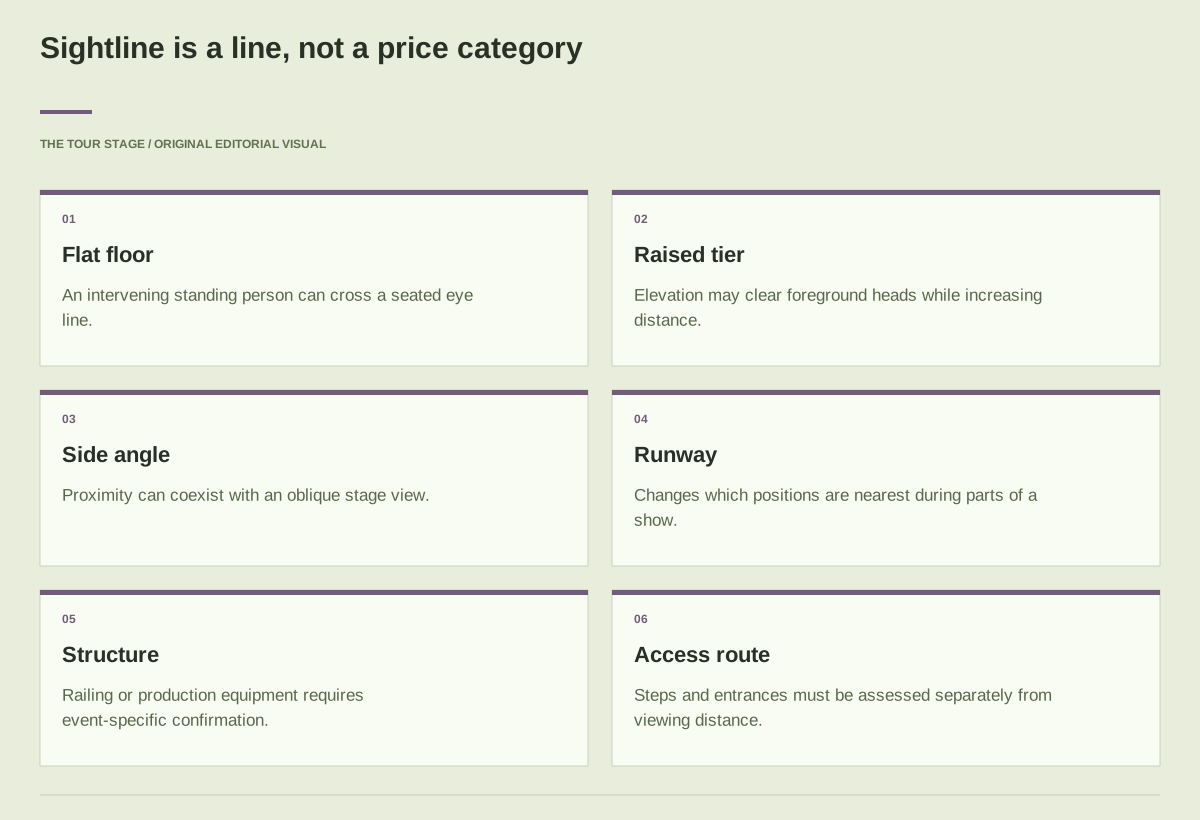
Sightline is a line, not a price category
- Flat floorAn intervening standing person can cross a seated eye line.
- Raised tierElevation may clear foreground heads while increasing distance.
- Side angleProximity can coexist with an oblique stage view.
- RunwayChanges which positions are nearest during parts of a show.
- StructureRailing or production equipment requires event-specific confirmation.
- Access routeSteps and entrances must be assessed separately from viewing distance.
Read the visual as text
- Flat floorAn intervening standing person can cross a seated eye line.
- Raised tierElevation may clear foreground heads while increasing distance.
- Side angleProximity can coexist with an oblique stage view.
- RunwayChanges which positions are nearest during parts of a show.
- StructureRailing or production equipment requires event-specific confirmation.
- Access routeSteps and entrances must be assessed separately from viewing distance.
Read restricted-view notes literally
A restricted-view warning is useful information, not a puzzle you should assume you can outsmart. The restriction might concern the stage angle, a structure or some part of the production. Ask what is affected if the listing is unclear. A low price does not tell you whether the lost view is acceptable for your priorities.
Do not convert a photograph from another show into a guarantee. Production towers, screens and sound positions can move. A seat-view image is most useful when it identifies the exact section, row and comparable configuration, and even then it remains one person’s perspective. Keep the ticket seller’s event notes in the decision. If you would be unhappy without a direct stage view, buy on that basis rather than hoping a screen will solve the problem. Screens are a performance feature to verify, not a universal substitute for a sightline.
Use official room charts for the building’s fixed features
The Opry’s seating page provides an official starting point for its room layout and accessible-seating information.1 A source like this is useful for orientation: levels, sections and the broad relationship to the stage. It does not remove the need to read the conditions of the particular event and ticket.
At historic theatres, a balcony can add both elevation and a different relationship to architectural features. At arenas, the floor can change more dramatically between productions. Describe the question you are trying to answer: “Does this row require steps?” or “Is there a railing directly ahead?” is more useful than asking if the balcony is good. A box-office response tied to the event and location can address a real need. General praise about the room cannot tell you whether that particular seat will suit you.
Access and companion arrangements belong in seat selection
Bridgestone Arena describes accessible and companion seating across its levels, including event floors when floor seats are offered.2 Ryman’s accessibility information describes its own routes, facilities and seating arrangements.3 These examples demonstrate why the building’s detailed information matters more than a category label such as lower level.
If steps, transfers, seat width, armrests or a route from the entrance affect your visit, make those questions part of the purchase. A short horizontal distance on a map can hide a difficult vertical route. A group may also need to coordinate companions and separate arrivals. The accessible-concert guide offers more detailed prompts. Do not reserve a location on the assumption that staff will be able to change it after arrival. Ask about the arrangement you need while meaningful options are still available.
A seat does not promise a seated audience
Reserved seating gives you an assigned location. It does not necessarily mean people in surrounding rows remain seated throughout the music. For a listener who needs to sit, elevation and the behaviour permitted by the event can matter as much as the presence of a chair. Ask the venue about a specific concern rather than relying on an informal rule from another show.
Likewise, aisle access can make breaks easier but may bring more passing traffic. A position near a concourse route can reduce walking while changing the atmosphere around your place. Those are trade-offs to assess, not defects that make the same seat wrong for everyone. For a Keith Urban show, decide what would help you stay engaged for the evening: a clear wider view, proximity or an easier route. Then compare the available tickets against that stated priority.
Make a shortlist with reasons, not scores
Choose two or three realistic options and record configuration, elevation, viewing angle, access route and checkout total. Add any unresolved restriction beside the ticket rather than hiding it in a separate note. You do not need a fabricated numerical rating to make the comparison precise. A clear reason such as “raised view and fewer steps” is more useful than a score whose assumptions are invisible.
Before paying, check that the final listing still matches the option you assessed. Ticket filters and resale offers can change what is selected. Save the confirmation, then follow the provider’s actual delivery instructions. The mobile-ticket guide covers entry preparation, while the venue-type comparison puts the seat inside the wider physical experience. Good seat selection ends with an explainable choice, not a claim that one row is objectively best for every country fan.
Sources & further reading
- Opry House seating chartsOfficial room layout and accessible-seating information.
- Bridgestone Arena accessibilityAccessible and companion seating across arena levels and event floors.
- Ryman accessibilityVenue-specific access routes, services and seating information.