Begin with the singer and the pulse
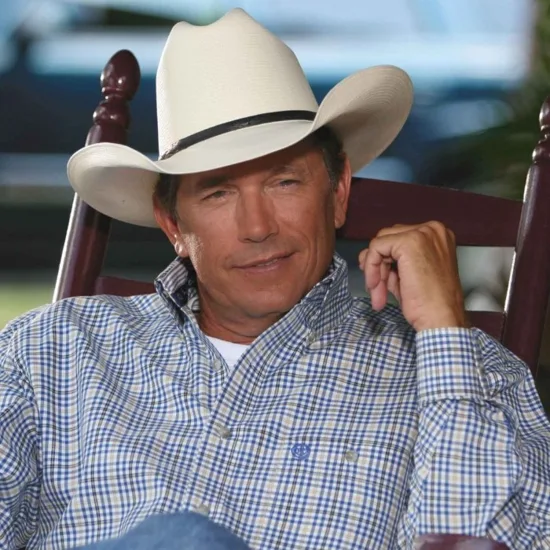
Put on George Strait’s “Amarillo by Morning” and resist the urge to identify every instrument. Follow the voice through one verse, then notice what moves around it: a fiddle phrase, an answering instrumental line, a rhythm that makes room for the singer. Country often makes its strongest impression through this division of labour. The words establish a person and a predicament; the band supplies momentum and emotional shading. A recording can be polished and still leave those relationships easy to hear.
The Country Music Hall of Fame describes Strait’s blend of traditional and contemporary sounds, rather than presenting him as a reconstruction of one earlier era. That is a helpful starting point for the whole genre. Country keeps old musical habits in circulation while changing recording technology, commercial settings and audiences. You do not need to choose a historical side before enjoying it. Listen first for how a performance persuades you to believe a particular voice.1
A compact first listening route
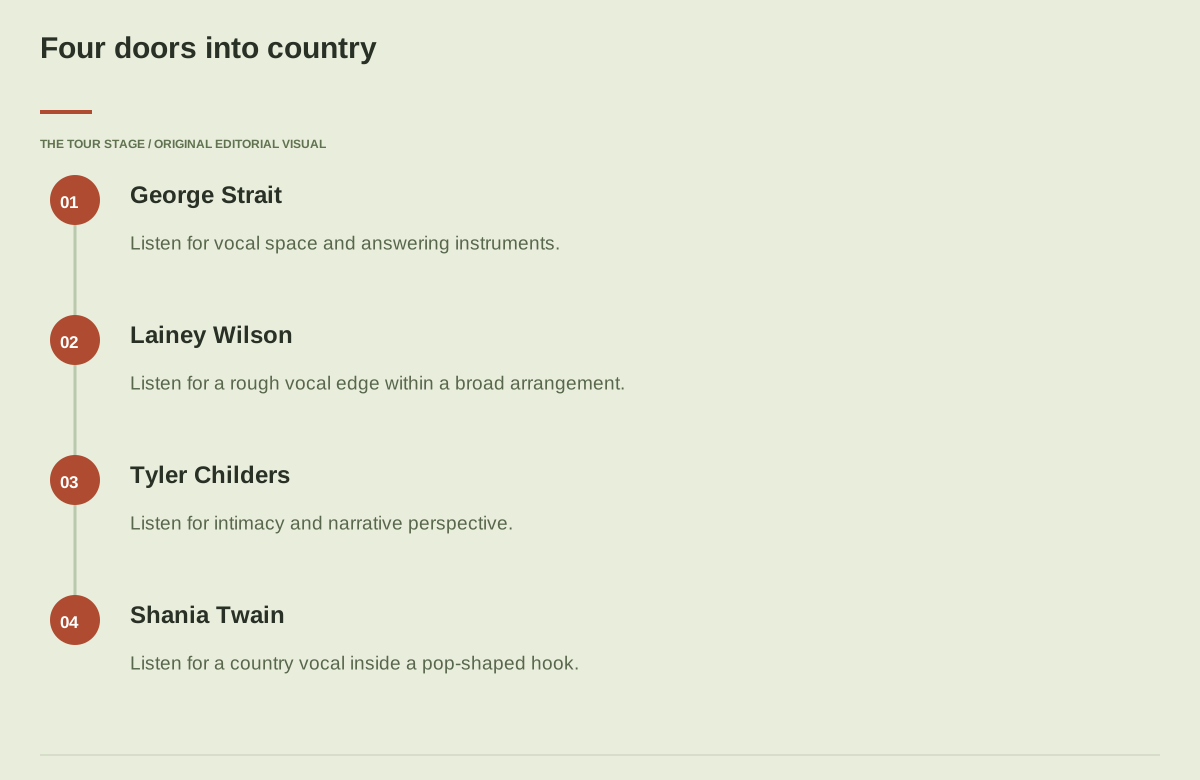
Start with Strait, then hear Lainey Wilson’s “Heart Like a Truck,” Tyler Childers’s “Lady May,” and Shania Twain’s “You’re Still the One.” These are four different entry points, not four boxes into which every country artist fits. Strait offers poised phrasing and instrumental conversation. Wilson brings a rougher vocal edge against a broad contemporary arrangement. Childers invites attention to the grain of a close, intimate performance. Twain makes country inflection work within an immediately legible pop song.
Play each recording once without stopping. On the second pass, choose just one question: what is carrying the rhythm, where does the singer leave space, or what changes when the chorus arrives? This is more useful than trying to absorb a century of history in a single sitting. Wilson’s official catalogue locates “Heart Like a Truck” on the Bell Bottom Country listening route; Childers’s official Purgatory listing includes “Lady May.” Keep album context attached to the song as you explore.23
Four doors into country
- George StraitListen for vocal space and answering instruments.
- Lainey WilsonListen for a rough vocal edge within a broad arrangement.
- Tyler ChildersListen for intimacy and narrative perspective.
- Shania TwainListen for a country vocal inside a pop-shaped hook.
Read the visual as text
- George StraitListen for vocal space and answering instruments.
- Lainey WilsonListen for a rough vocal edge within a broad arrangement.
- Tyler ChildersListen for intimacy and narrative perspective.
- Shania TwainListen for a country vocal inside a pop-shaped hook.
Hear the difference between a shuffle and a slow song
Rhythm words describe movement, not quality. A shuffle has an uneven, rolling subdivision; a straight beat divides the pulse more evenly. A waltz groups the main beats in threes. None of these descriptions requires a particular lyric subject or a cowboy image. Tap along gently before deciding what you hear. If you lose the pulse, return to the bass or the most regular percussion sound instead of following the singer, who may stretch a line across it.
A slow performance can feel intense because the vocal and the beat do not land together mechanically. A danceable track can contain a wounded narrator. Those combinations are part of country’s expressive range. Avoid translating every upbeat record into “happy” and every sparse arrangement into “sad.” The interesting work frequently happens between those easy categories. Our honky-tonk guide follows that relationship between musical motion and emotional trouble in more detail.
Let instruments become familiar voices
A fiddle is the violin in a musical role associated with traditions such as dance music and country; the name does not mean an entirely different instrument. Steel guitar is a different family of sound: sustained notes can slide and change pitch in ways that resemble a second singer. An electric guitar may give a sharp, short answer to a vocal line, while acoustic guitar often helps articulate the pulse. Instruments can overlap in register, so identify a gesture before trying to name the player.
Try listening during the gap after a sentence. Does the band answer, sustain a chord, or pull back? That tiny space can reveal more than a long solo. Then compare another track by the same singer. A recording with less steel is not automatically less country, and prominent banjo does not automatically make a track bluegrass. Arrangement is a set of choices inside a performance. For a fuller ensemble comparison, continue to bluegrass versus country.
Follow storytelling without demanding a plot twist
Country storytelling includes fully developed events, but it also includes a sharply observed situation: someone considering a departure, remembering a relationship, or putting on a brave face. Ask who is speaking, who is being addressed, and what the speaker wants. A character can misunderstand the situation; a narrator’s declaration does not have to be the artist’s personal confession. Treat the recording as an acted scene before treating it as autobiography.
Notice how a chorus changes meaning after a later verse. Sometimes the words repeat while your understanding shifts. Sometimes a final instrumental passage lets the feeling remain unresolved. This is why jumping directly to the biggest hook can miss the record’s work. Listen to the opening as setup and to the ending as a decision about what remains with you. Our story-song feature develops these questions without reproducing the songs’ lyrics.
Production can widen the doorway
Shania Twain is useful here because her catalogue makes the existence of different album editions visible. The official Come On Over stores distinguish US and international versions; a listener comparing editions should check the release label rather than assume every upload contains the same arrangement. The point is not to decide which version wins. Ask what comes forward: a vocal hook, a rhythmic accent, a layered background part, or an instrument associated with country tradition.4
Large choruses, close vocal editing and bright rhythm tracks can make a country song welcoming to a listener raised on pop. A more exposed performance can make a familiar lyric feel conversational. Both are production choices. Twain and Wilson offer different ways into that discussion; follow the country-pop comparison when you want to hear how recording decisions shape the boundary.
Turn four songs into four albums
After the sampler, choose the record that made you want to hear the next track. Give that album one uninterrupted listen, keeping a short note of three moments: a compelling opening, a surprising middle, and an ending that changes the mood. You are building a vocabulary out of experience. If the first album is uneven for your taste, that is useful information about your preference, not evidence that the genre has failed you.
Use George Strait for a route into economical singing and dance-band textures, Tyler Childers for close attention to narrative voice, Wilson for contemporary country with a strong vocal identity, and Twain for crossover arrangement. Next, move sideways to one unfamiliar artist rather than only backward through a greatest-hits canon. Country makes more sense as a network of conversations than a ladder with one correct first rung. Keep the songs that reward another listen; return to the rest when your ear has changed.
Sources & further reading
- Country Music Hall of Fame: George StraitCareer context and traditional/contemporary blend.
- Lainey Wilson official musicBell Bottom Country catalogue entry.
- Tyler Childers official Purgatory listingAlbum title and track listing.
- Shania Twain official Come On Over editionsUS and international edition distinction.