There are two works to keep in view
A song and a particular recording of that song are distinct creative works. The U.S. Copyright Office explains that the underlying musical composition and the sound recording have separate copyrights.1 For listening purposes, this is the essential distinction: the writers created the composition, while performers and recording personnel made this recorded version.
A new singer can record the same song without becoming its original writer. A songwriter can contribute to a famous record without singing on it. A featured vocalist can appear on a master without necessarily having written the composition. The examples below explain how to read those credits; they are not a guide to calculating payments or clearing music for use. Those questions need the actual rights information and circumstances, rather than a simplified inference from a streaming screen.
Read a fictional credit block one line at a time
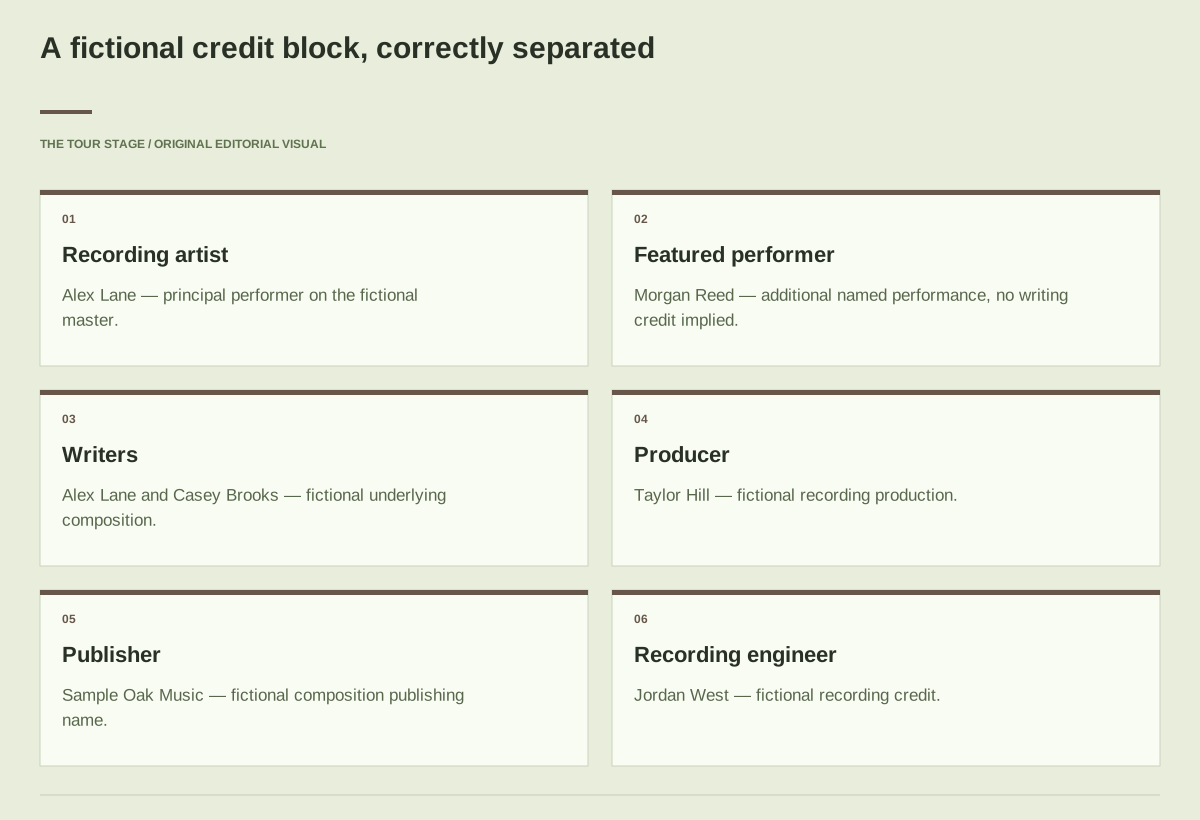
Consider a deliberately fictional example: “River Road, performed by Alex Lane featuring Morgan Reed; written by Alex Lane and Casey Brooks; produced by Taylor Hill; published by Sample Oak Music; recorded by Jordan West.” None of those invented names represents a real release here. They let us separate functions without attributing an imaginary credit to an existing artist.
Lane is the principal recording artist and one co-writer. Reed is identified as a featured performer, not automatically a writer. Brooks shares authorship of the composition without being identified as a vocalist. Hill’s production credit concerns the record; West’s recording credit identifies a different task. Sample Oak Music is the named publisher, not a band member. One real person could hold several of those jobs, but each role needs its own evidence. The visual uses separate rows so that a famous name cannot visually swallow the rest of the team.
A fictional credit block, correctly separated
- Recording artistAlex Lane — principal performer on the fictional master.
- Featured performerMorgan Reed — additional named performance, no writing credit implied.
- WritersAlex Lane and Casey Brooks — fictional underlying composition.
- ProducerTaylor Hill — fictional recording production.
- PublisherSample Oak Music — fictional composition publishing name.
- Recording engineerJordan West — fictional recording credit.
Read the visual as text
- Recording artistAlex Lane — principal performer on the fictional master.
- Featured performerMorgan Reed — additional named performance, no writing credit implied.
- WritersAlex Lane and Casey Brooks — fictional underlying composition.
- ProducerTaylor Hill — fictional recording production.
- PublisherSample Oak Music — fictional composition publishing name.
- Recording engineerJordan West — fictional recording credit.
A real co-write: Greylan James and Jordan Davis
MCA identifies Jordan Davis, Chase McGill, Josh Osborne and Greylan James as writers of “Next Thing You Know.”2 Davis’s position as recording artist does not erase the other three authors. Equally, James’s writing credit does not make the record a duet between Davis and James.
When you see the title on another release, check whether it is the same composition and a different recording. Titles are not unique identifiers by themselves. Writer names help distinguish songs that happen to share a name, while a particular album or single identifies the recording you are hearing. The songwriting-to-record case study follows this example further, keeping documented public milestones separate from the private details of how a songwriting room actually worked.
What publisher databases can answer
A music publisher’s name concerns the composition’s publishing interests, not necessarily ownership of the recording. BMI’s Songview explanation describes its public repertory information for songwriters, publishers and shares.3 Such a database is a useful tool for investigating who is associated with a work, especially when a streaming display supplies only a partial view.
Search with both title and writer when possible. Check for variant titles, multiple works and the particular record you mean. Do not turn an incomplete search result into a declaration that someone had no role. Likewise, a database share should not be casually translated into an artist’s take-home income; agreements and revenue streams are different questions. For ordinary discovery, the reward is simpler: a writer’s name can lead you to another singer’s record, revealing a creative connection that the artist name on the cover does not show.
Cover, feature, sample and interpolation name different relationships
A cover is a new performance of an existing song. A feature names an additional artist’s participation in a recording. A sample reuses recorded sound; an interpolation re-performs material from an existing composition. Those are useful descriptive distinctions, but a credit list alone may not establish every detail of a complicated borrowing. Use an official release explanation or the relevant documented credits.
A duet can be a cover, and a featured artist can also be a writer. The categories can overlap because they answer different questions. Avoid using “collaboration” as the only label when more precise words are available. The duet guide explores vocal roles, while cross-genre collaborations considers partnerships across different sounds. In each case, identify the actual work and version before describing the relationship. A shared stage appearance is not automatically a joint studio recording.
Performance credits tell you who made the sound
Instrumental and vocal credits can distinguish band members, guests and session musicians. A player credited on an album may not appear on every track, and a touring musician seen in a recent video may not have played on an earlier studio master. Credits that name a specific track are more precise than an undifferentiated personnel list.
When listening to Brothers Osborne or Mike Ryan, treat a striking guitar or fiddle passage as the beginning of an investigation. Check the release booklet, official credits or label notes before naming the performer. If no reliable track-level evidence is available, describe what you hear without attaching a guessed musician. That is better criticism than confident misidentification. It also gives session players the chance to be recognised accurately when the evidence is available.
Build a reliable credit note for one song
Write four headings: composition, recording artist, featured performers and production personnel. Fill them from the best available official sources and keep the exact version beside them. Add publisher information separately if you need it. Empty fields can remain empty until the evidence resolves them; an attractive diagram should never require a fabricated name.
Finally, add your own listening note in a different sentence. “The steel answers the singer” is an interpretation of the arrangement. “This named musician played steel on this master” is a factual credit claim. Keeping those apart makes both stronger. The habit is especially valuable when an artist is also a writer, producer and instrumentalist, because it prevents one established role becoming an assumption about all the others. Continue with the producer guide for the next layer of how people help shape a finished country record.
Sources & further reading
- U.S. Copyright Office: compositions and recordingsDistinction between underlying song and particular sound recording.
- MCA: Next Thing You Know releaseSongwriters Jordan Davis, Chase McGill, Josh Osborne and Greylan James.
- BMI: SongviewPublic songwriter and publisher repertory data and reconciliation.