
Read the credit before drawing the connection
A cut is a recording of a writer’s song by an artist. Co-writing does not necessarily mean the writer played on that recording, sang a harmony, produced the session or wrote every memorable line alone. Those roles need their own credits. This guide follows Adam Sanders, Greylan James, John Morgan and Mike Ryan through named releases with documented authorship. New describes an editorial discovery route through writer-performers, not the age of every song. Several examples have been in listeners’ lives for years. The network visual should be read as writer-to-recording links, with co-writing understood throughout. It is not a claim that these musicians wrote a whole catalogue for another singer or own the meaning of every performance of a song.
Adam Sanders to Dustin Lynch and Cole Swindell
Round Hill Music’s publishing announcement documents Adam Sanders as a writer behind Dustin Lynch’s “Hell of a Night” and Cole Swindell’s “Ain’t Worth the Whiskey.” Begin by listening to the released recordings, then turn to Sanders’ own “What If I’m Right.” The exercise is not to identify which individual writer supplied a line without evidence. It is to hear a person’s artist voice after discovering their work in another singer’s catalogue. A large, open chorus can accommodate different vocal personalities; a rhythmic phrase that feels effortless may be the product of careful writing. The publisher source establishes the authorship connection. Your observations about hooks and delivery remain editorial interpretation, which should not be confused with a documented account of the writing session.1
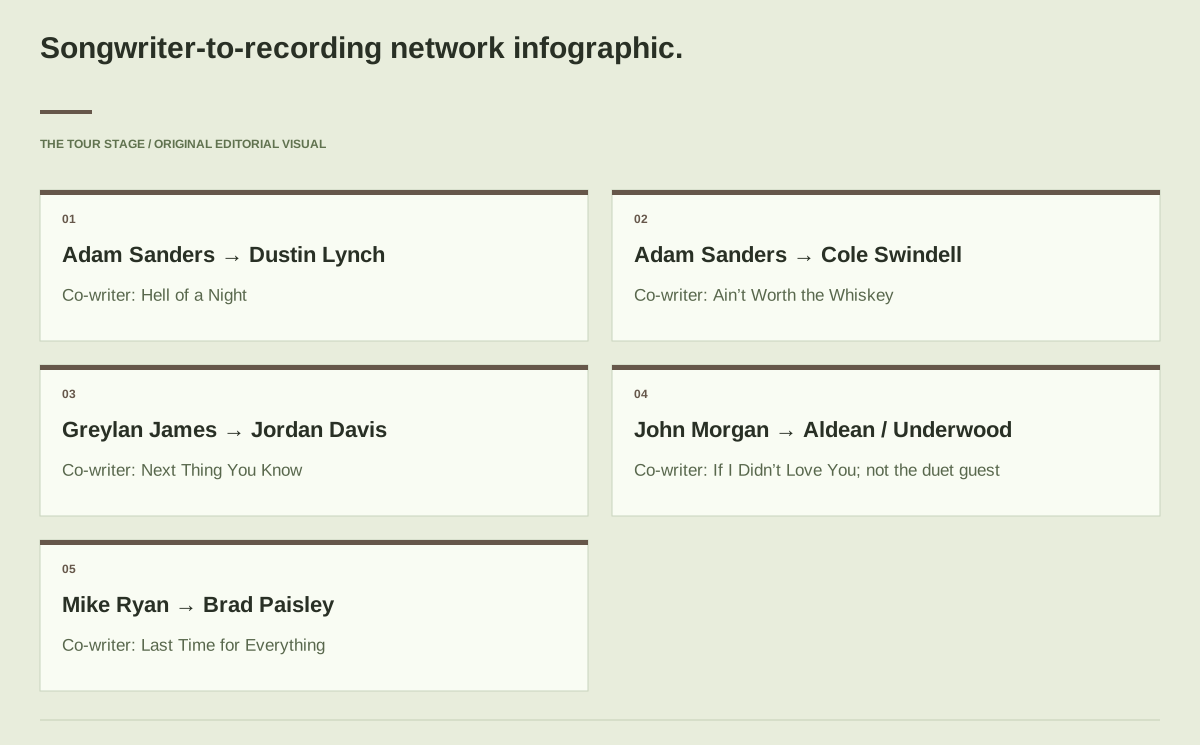
Songwriter-to-recording network infographic.
- Adam Sanders → Dustin LynchCo-writer: Hell of a Night
- Adam Sanders → Cole SwindellCo-writer: Ain’t Worth the Whiskey
- Greylan James → Jordan DavisCo-writer: Next Thing You Know
- John Morgan → Aldean / UnderwoodCo-writer: If I Didn’t Love You; not the duet guest
- Mike Ryan → Brad PaisleyCo-writer: Last Time for Everything
Read the visual as text
- Adam Sanders → Dustin LynchCo-writer: Hell of a Night
- Adam Sanders → Cole SwindellCo-writer: Ain’t Worth the Whiskey
- Greylan James → Jordan DavisCo-writer: Next Thing You Know
- John Morgan → Aldean / UnderwoodCo-writer: If I Didn’t Love You; not the duet guest
- Mike Ryan → Brad PaisleyCo-writer: Last Time for Everything
Greylan James to Jordan Davis
Greylan James’ official biography identifies his co-writing connection to Jordan Davis’ “Next Thing You Know.” Listen to how the song’s narrative progresses: its power depends on accumulating changes rather than merely repeating a static situation. Then hear James as the recording artist on “Young Man.” Comparing the two makes room for a writer to have a recognisable concern with time and consequence without assuming every release repeats the same trick. An artist can keep one song for their own catalogue and contribute another to a different singer’s record. That distinction is a practical part of a songwriting career. It is also a useful discovery tool: a credit leads you to music that an algorithm focused only on vocal resemblance might not immediately place beside your favourite record.2
John Morgan to an Aldean–Underwood duet
Jason Aldean’s official announcement for “If I Didn’t Love You” names John Morgan alongside Kurt Allison, Tully Kennedy and Lydia Vaughan as the writers, with Michael Knox producing. The released duet features Aldean and Carrie Underwood. Those are three separate relationships: authorship, production and the principal vocal performance. Morgan’s credit does not make him the duet partner. Now move to John Morgan’s own “Friends Like That,” which has a recording featuring Aldean, and note that the relationship has changed. In one case Morgan is among the writers behind someone else’s record; in the other his own artist release contains a named vocal guest. A network that labels both edges collaboration would conceal the most useful detail.3
Mike Ryan to Brad Paisley, and a different return link
The Opry’s official artist page documents Mike Ryan as a co-writer of Brad Paisley’s “Last Time for Everything.” It also describes Paisley playing lead guitar on Ryan’s “The Rewrite.” That return connection is instrumental performance, not the same kind of credit travelling in reverse. Listen to the Paisley recording for how a song organises memories, then hear the Ryan track for the guitar’s relationship to the voice. A musician can connect two catalogues through more than one job, and the distinction improves the listening. You can hear a particular instrumental contribution without pretending to know which writer supplied a melody. Treat the Opry’s dated biographical numbers cautiously; the concrete recording relationships are the evidence relevant here.4
Why the singer still changes the song
A writer’s demo or acoustic performance can illuminate the song’s structure, but it does not supersede the released interpretation. Tempo, key, phrasing, harmony voices and production can all move the listener’s attention. A singer may make a lyric sound resigned where another makes it defiant. The underlying composition can support both readings. When comparing versions, identify what is actually shared: the lyric and melody may remain while the groove changes; an introduction may be added; a bridge may feel different because of dynamics. Avoid calling every difference an improvement. The question is what each recording makes audible. The Nashville songwriter-room guide explains why hearing a writer live is especially revealing when a familiar full-band record has become fixed in your memory.
Build a credit trail you can trust
Start with the recording’s exact title and artist, then check official label material, publisher records or the recording’s supplied credits. A song title alone is insufficient because unrelated compositions can share it. Record all named co-writers rather than presenting the artist you recognise as the sole author. Keep production and featured-vocal information in separate columns. If a source identifies only a broad list of artists who have recorded a writer’s work, do not invent a specific song to fill a network edge. A smaller network of verified connections is more useful than an impressive-looking web of guesses. This method also helps when exploring duets in the harmony-group guide or following the collaboration links in another artist’s catalogue.
A listening session with eight different viewpoints
Make pairs: the outside cut and one artist recording for Sanders, James, Morgan and Ryan. Listen to the outside cut first, then reverse the pair on a second pass. Notice whether knowing the writer changes your attention to structure, while keeping claims about intent tied to a first-person source. None of these pairs establishes that all the songs share one writing style. Their value is showing how discovery can follow a creative role rather than a popularity chart. When a song catches you next time, open the credits before searching only for similar singers. You may find another recording artist, a specialist writer or a producer whose work creates a whole new route through country music. The artist finder supplies a complementary route through sound.
Sources & further reading
- Round Hill Music: Adam SandersCo-writing cuts for Lynch and Swindell.
- Greylan James official biographyNext Thing You Know co-writing and artist context.
- Jason Aldean: If I Didn’t Love You announcementFull four-writer list, principal duet singers and producer.
- Opry: Mike RyanLast Time for Everything co-write and Paisley guitar on The Rewrite.
- John Morgan official websiteFriends Like That artist release and Aldean feature.