
Start with the format, then choose the room
A songwriter round is a way of presenting songs: several writers take turns, usually sharing a stage or the middle of a room. A listening room is an audience agreement: conversation gives way to the performance. A full-band club describes neither a fixed repertoire nor a compulsory party atmosphere. Those categories overlap, but they are not interchangeable. A writer can bring a band into a listening room; an acoustic show can take place in a noisy bar. Read the individual event description before deciding what experience a venue name promises. The useful question is whether you want to follow a lyric, observe musicians exchanging ideas, or feel a rhythm section move the room. Nashville offers all three without requiring a stop on Lower Broadway.
The Bluebird: hearing songs change hands
The Bluebird Cafe describes its signature round as three or four writers seated in the centre of the room, taking turns with songs and their stories. Its own FAQ makes the listening expectation explicit: sustained conversation distracts both writers and listeners. That intimacy is the musical attraction, rather than a guarantee that a famous guest will appear. A writer may introduce a recording you recognise, then reveal a different vocal emphasis in their own version. Listen for the phrase that survives the change of singer. Does the chorus become more conversational without the recorded drums? Does a comic introduction change how a serious verse lands? Those are pleasures peculiar to the format. Treat the published bill as the reason to attend, and any unannounced visitor as incidental.1
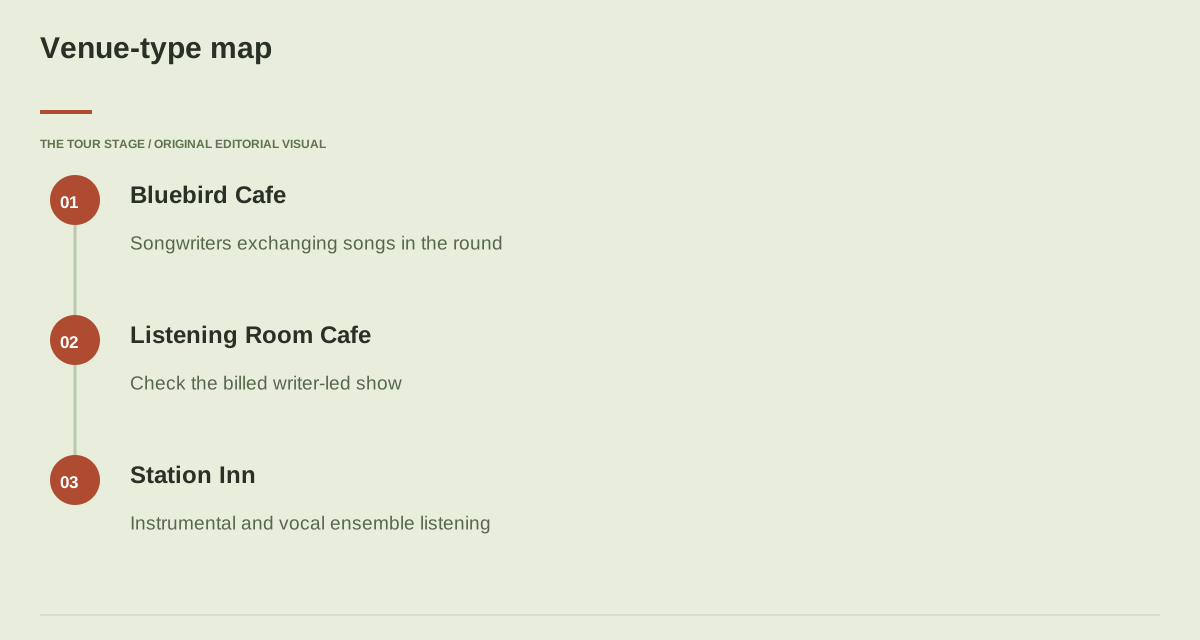
Venue-type map
- Bluebird CafeSongwriters exchanging songs in the round
- Listening Room CafeCheck the billed writer-led show
- Station InnInstrumental and vocal ensemble listening
Read the visual as text
- Bluebird CafeSongwriters exchanging songs in the round
- Listening Room CafeCheck the billed writer-led show
- Station InnInstrumental and vocal ensemble listening
The Listening Room: writers in a staged setting
The Listening Room Cafe provides another route into songwriter-led Nashville. Its event listings are the place to distinguish a writers round from a special concert, benefit or other booking. Do not assume that a table, food service or a larger stage removes the obligation to listen. The practical advantage of researching a bill is that you can trace the writers before arriving: look for their own artist releases as well as songs recorded by someone else. Greylan James is a useful listening example of that dual identity. Hearing his own singing alongside a song he helped write for another artist reveals that the writer credit and the voice on a familiar recording are different jobs. Neither room guarantees a particular writer on a particular night.2
Station Inn: follow the ensemble conversation
Station Inn calls itself a listening room in the Gulch and identifies bluegrass, classic country, Americana and roots music within its programming. That makes it a valuable alternative when you want instrumental exchanges as much as explanations between songs. A fiddle answer, a bass note that redirects the harmony, or a mandolin chop can carry the conversation that spoken introductions carry in a round. Its calendar remains the authority on a given act. Avoid treating every booking as a strictly acoustic bluegrass demonstration. The venue also warns that parking in the Gulch can be difficult and provides its own guidance. Budget time to arrive, find the entrance and settle into the audience rather than constructing a cross-city sprint between sets.3
Prepare with three kinds of recording
Use Brandy Clark to practise hearing a lyric as a sequence of decisions: who knows what, when the scene changes, and how a chorus gains meaning on its return. With James, compare an artist performance with the published credit behind another singer’s record. With Emily Ann Roberts, attend to how a clear traditional-country vocal can make the same consonants sound tender in one verse and emphatic in another. These are listening preparations, not claims that these artists are scheduled at the rooms above. A short preparation playlist is more useful than attempting to memorise everyone’s biography. Choose one complete song per writer, then leave room for surprises in the live set. The songwriter-to-recording guide develops that distinction further.
Etiquette that protects the performance
Finish conversations before a verse begins. Put a bright phone screen away, avoid holding a device above another person’s sightline, and follow the room’s photography rules. In a round, applause after a song is welcome; interrupting a quiet ending with a shouted request may erase the very detail the room exists to share. If food or drink is served, order with awareness of the performance rather than projecting across a table. Do not assume an empty chair is yours or that another ticket holder’s table permits extra guests. Respect staff directions about late entry. For access needs, ask the venue specific questions about step-free arrival, seating, toilets and the view from the offered position. A general description such as intimate tells you little about those practical details.
Build one convincing evening
Choose one main show and make dinner, travel and any later music fit around it. Compare the event’s start time with the venue’s arrival instructions, rather than treating doors and performance as synonyms. Check whether the ticket is admission only, whether there is a purchase requirement, and whether seats or tables are assigned. These are event-specific questions, so this guide does not turn a historic venue description into a fixed policy. A full-band stop afterwards can be rewarding precisely because the contrast is strong: you have spent an hour hearing a lyric exposed, then hear country music through collective momentum. For a different city’s room choices, compare Austin’s roots venues; for the dancing end of the spectrum, explore Texas dance halls.
Make a useful note after the show
Write down one writer, one unfamiliar song title and one musical detail while they are still fresh. Separate something the performer actually said from your own interpretation. A story told onstage may illuminate a song without providing a complete publishing history, so verify credits through the artist or publisher before passing them on. The following day, listen to the released recording and notice what the room changed: tempo, introduction, vocal grain or the silence around a line. That comparison turns a visit into a continuing listening habit. It also gives a better answer to where to go next than simply collecting the most famous venue names. You are choosing the conditions under which you most enjoy hearing a song.
Sources & further reading
- Bluebird Cafe: about and performance formatSignature round format and songwriter focus.
- The Listening Room CafeOfficial venue and event-programming entry point.
- Station InnListening-room identity, genres, calendar and parking guidance.
- Bluebird Cafe FAQAudience listening expectations and visit policies.