
Describe a good festival day before choosing a festival
Imagine the middle of your ideal afternoon. Are you listening closely to a songwriter, moving between bands with friends, finding a dance floor, or saving your energy for a large evening production? Those are different experiences even when several of the same artists appear on their posters. Write one sentence about the experience you want and one about the thing most likely to spoil it. “Plenty of unfamiliar roots acts, but a reliable place to sit” gives you a more useful search than “a great atmosphere.”
Choose three musical anchors rather than one indispensable performer. A listener drawn to Lainey Wilson, Jelly Roll and The Red Clay Strays can use those preferences to investigate a bill without assuming any particular festival has booked all three. Check the exact edition and day before making a purchase.
Compare four shapes of festival
A camping festival combines the concert and overnight environment; much of your decision concerns equipment, sleep and arrival. A city showcase weekend distributes experiences across an urban area, making accommodation location and transfers important. A stadium-centred programme creates a defined evening destination, but its admission may be separate from daytime activities. A destination weekend asks you to organise a whole trip around the festival, including extra nights and the journey home.
These categories can overlap. CMA Fest’s authorised Ticketmaster listing for the 2026 edition distinguished free daytime stages from ticketed stadium and other activities. That is an example of why “festival admission” can be several different products rather than one universal wristband.1 Do not compare a free afternoon outdoors with another event’s full weekend package as if they deliver identical access. Describe what each candidate actually includes.
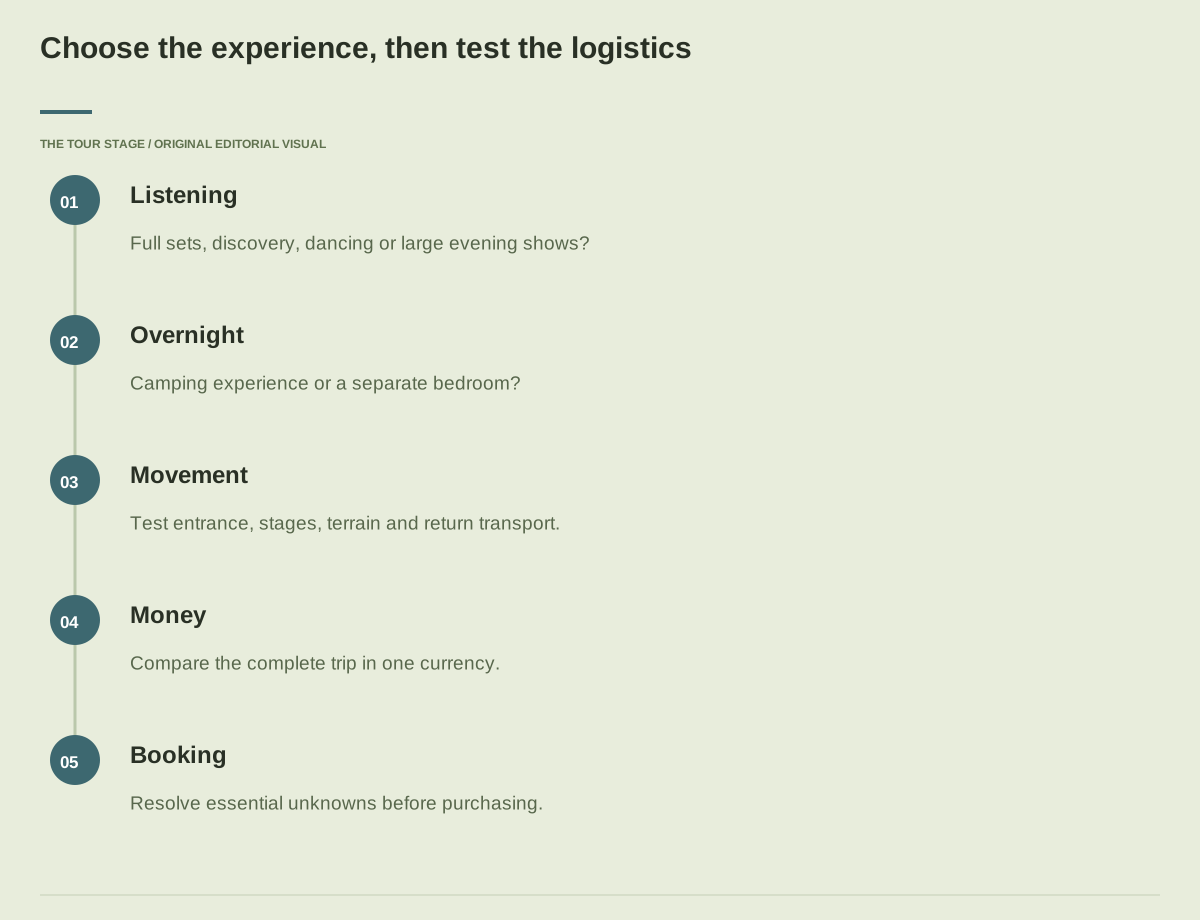
Choose the experience, then test the logistics
- ListeningFull sets, discovery, dancing or large evening shows?
- OvernightCamping experience or a separate bedroom?
- MovementTest entrance, stages, terrain and return transport.
- MoneyCompare the complete trip in one currency.
- BookingResolve essential unknowns before purchasing.
Read the visual as text
- ListeningFull sets, discovery, dancing or large evening shows?
- OvernightCamping experience or a separate bedroom?
- MovementTest entrance, stages, terrain and return transport.
- MoneyCompare the complete trip in one currency.
- BookingResolve essential unknowns before purchasing.
Make sleeping arrangements a first decision
Camping is attractive if you want to stay inside the festival rhythm and avoid a nightly trip. A hotel can make sense if a shower, a proper bed or a quieter retreat is essential. Neither is automatically easier. A campsite may involve carrying everything from a remote unloading point; a hotel may involve queuing for transport at the same time as thousands of other guests. List the complete chain from the final song to your pillow.
Stagecoach’s Resort information separates camping credentials from festival admission: an RV site is not an admission ticket. Its current planning pages were in the 2027 sales cycle when checked on 8 November 2026.2 Use that distinction as a booking question, rather than copying a pass arrangement from an older visit. The camping and hotel comparison provides a more detailed worksheet.
Read the map for effort, not just distance
Find the entrance, stages, toilets, water, food, accessible routes and transport stop. Then trace an actual afternoon through them. A site that looks compact can still require detours around a fence, queues at a crossing or a climb between performances. A map is evidence about layout; it rarely promises a walking time. If terrain or standing time matters, consult the organiser’s accessibility information before treating a scenic location as a practical choice.
MerleFest’s current festival information specifically warns about hills and uneven ground while describing stage accessibility.3 That combination illustrates a useful distinction: accessible infrastructure and an effortless journey are different questions. Ask about the route you would use, any vehicle assistance and the practical distance from your accommodation or drop-off. Consider whether the group can comfortably repeat that journey after dark and in rain.
Build a whole-trip ceiling
Set a total you are comfortable spending before comparing ticket tiers. Include admission, compulsory fees, accommodation, transport, food, equipment you actually need and a reserve. Add arrival and departure nights if your journey requires them. A relatively inexpensive ticket can become the more expensive trip once flights and an extra hotel night are included. Conversely, accommodation beside an entrance may remove a transport problem that would otherwise undermine the weekend.
Separate firm quotes from guesses. Keep a note of which edition, dates, room occupancy and cancellation terms each quote covers. If one candidate is available only with a non-refundable commitment, consider the exposure alongside its advertised cost. The festival budget calculator supports a transparent estimate using your own figures. It is most useful after you have identified the required products, not as a substitute for checking them.
Test the timetable against your listening habits
A huge bill does not mean you can hear every act. Decide whether you enjoy complete sets or sampling several performances. A listener who wants the story of a whole show may prefer fewer stage changes; a discovery-minded group may happily leave a gap for an unfamiliar band. Neither approach measures musical seriousness. Both work better when the schedule leaves room for food and rest.
Use the previous edition’s schedule to understand the event’s structure, while keeping it clearly labelled as historical. It can reveal whether afternoons are dense with overlaps or whether major sets dominate the evening. It cannot confirm a future artist’s day or stage. Once the correct timetable appears, use the clash-planning guide to make a realistic route. If your preferred artists occupy incompatible slots, decide which full performance matters most before arriving.
Give each option a short, honest scorecard
For each shortlisted festival, write five answers: musical fit, sleeping arrangement, arrival plan, daily physical effort and complete estimated spend. Mark each answer “confirmed,” “assumed” or “unknown.” A cheap but unknown transfer is still an unresolved transfer. Ask the organiser a precise question such as whether your ticket allows campsite access, rather than asking whether the festival is suitable for beginners.
Weight the factors according to your needs. Give an essential requirement veto power instead of letting four small advantages outweigh it. If reliable step-free access is necessary, a slightly stronger lineup cannot compensate for an unsuitable route. If camping is the main attraction, a city hotel package may be a poor fit despite convenience. Keep the notes short enough to compare side by side, and record the date you checked each policy.
Choose a manageable first version of the trip
A first visit does not need every upgrade or every available day. A single day can test whether you enjoy a large crowd and long outdoor programme. A weekend may make more sense when travel is substantial or camping is integral to the experience. Choose the duration that gives you enough music without forcing an exhausting arrival or departure. Leave an uncommitted block for exploring the grounds.
Before paying, review the organiser’s current ticket descriptions, permitted items, accommodation conditions and transport instructions once more. Save the confirmation where you can reach it without relying on mobile reception. Then make a simple arrival plan and a small listening shortlist. A successful first festival is one where you can enjoy the music you came for and discover something unexpected while staying within the practical limits you set.
Sources & further reading
- CMA Fest authorised Ticketmaster listing, 2026 FAQ2026 distinction between free daytime performances and ticketed experiences; not a 2027 access guarantee.
- Stagecoach Resort and camping informationCurrent 2027 sales-cycle page separates RV-site purchase and festival admission; checked 8 November 2026.
- MerleFest festival informationOrganiser describes terrain and stage accessibility; page updated October 2026.