
Enter a timetable with a clear edition label
Start with the organiser’s published schedule for the edition you will attend. Copy the date, start, finish and stage for each set you are considering. Distinguish an artist’s appearance on a lineup from a confirmed performance slot. MerleFest’s archived 2026 printable schedule and site map provide separate evidence for times and locations; neither is a schedule for a later edition.12 Check the organiser again before travel for revisions.
The illustrative entries below are invented planning exercises, not bookings or predictions. Use generic labels until you have verified real information. If you are considering Sierra Ferrell, Billy Strings or The Infamous Stringdusters, enter their names only after checking the actual event’s schedule. The tool does not retrieve or verify it for you.
Choose anchor sets before optimising the gaps
Give yourself a small number of anchors: performances you want to hear from beginning to end. An anchor might be an unfamiliar artist whose records intrigued you, rather than the largest name on the poster. Write a short reason such as “hear the acoustic arrangements” or “share this set with my sister.” This makes later decisions easier than an undifferentiated list of favourites.
Then add flexible possibilities around those anchors. Leave some artists unassigned so the day can respond to weather, tiredness or a recommendation from another listener. A plan filled to every minute tends to turn delays into frustration. A useful schedule creates space for attention. If your main interest is discovery, the lineup-reading guide helps identify a few unfamiliar acts without producing another impossible checklist.
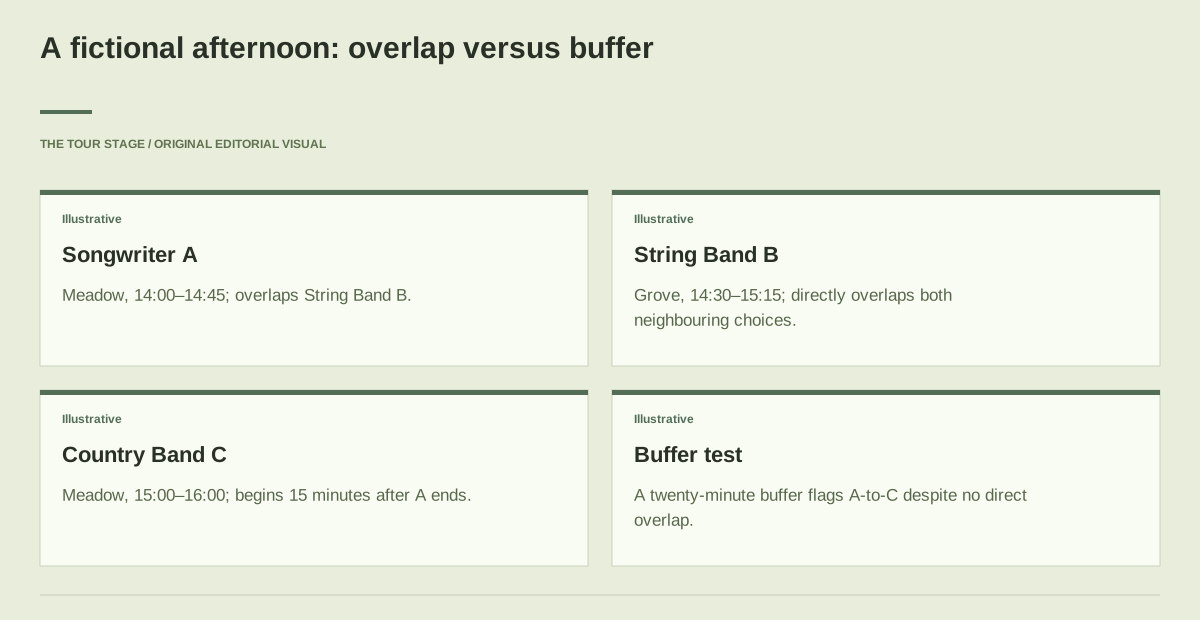
A fictional afternoon: overlap versus buffer
- Illustrative · Songwriter AMeadow, 14:00–14:45; overlaps String Band B.
- Illustrative · String Band BGrove, 14:30–15:15; directly overlaps both neighbouring choices.
- Illustrative · Country Band CMeadow, 15:00–16:00; begins 15 minutes after A ends.
- Illustrative · Buffer testA twenty-minute buffer flags A-to-C despite no direct overlap.
Read the visual as text
- Illustrative · Songwriter AMeadow, 14:00–14:45; overlaps String Band B.
- Illustrative · String Band BGrove, 14:30–15:15; directly overlaps both neighbouring choices.
- Illustrative · Country Band CMeadow, 15:00–16:00; begins 15 minutes after A ends.
- Illustrative · Buffer testA twenty-minute buffer flags A-to-C despite no direct overlap.
Understand what the clash calculation means
The planner compares user-entered dates and start/end times, using a buffer you choose for moving between stages. A direct overlap means two selected intervals occupy some of the same time. A buffer clash means a pair may avoid direct overlap but leave too little transfer time under your chosen allowance. These are planning flags, not a statement that a route is physically impossible or guaranteed.
Use a consistent local date and time convention. A performance that continues past midnight belongs across two calendar dates; enter its actual start and finish dates if the interface provides them, or split it into dated entries. Do not make a late-night finish appear earlier than its start. Check the printed result after editing. The owner’s implementation supports editable slots and a buffer; the article does not claim live routing, weather predictions or official capacity data.
Try this fictional clash before entering your own day
| Illustrative date | Set | Stage | Start–finish |
|---|---|---|---|
| 12 June 2027 | Songwriter A | Meadow | 14:00–14:45 |
| 12 June 2027 | String Band B | Grove | 14:30–15:15 |
| 12 June 2027 | Country Band C | Meadow | 15:00–16:00 |
Every name, stage and slot in this table is fictional. A overlaps B for fifteen minutes. A ends fifteen minutes before C begins. With a twenty-minute planning buffer, A-to-C also raises a warning. Changing the buffer changes that warning, but does not alter the actual overlap between A and B. Try keeping A and C, then shortening the buffer only if your verified route justifies it. The exercise teaches the distinction between timing and transfer assumptions.
Estimate the route from the map, then reality
Locate the real stage entrances and any marked crossings rather than measuring a straight line between stage names. Add time for getting out of a crowd, using an accessible route and reaching the next viewing area. The MerleFest 2026 map distinguishes multiple stage locations and support facilities; a reader can use it to understand the campus layout without inventing a universal walking speed.2
At arrival, test one important transfer while the site is less busy and revise your allowance if needed. The Long Road’s dated 2026 guide directed guests to its app for the full set times, illustrating why a saved personal plan should be checked against official updates.3 Keep a less demanding alternative for any transfer that depends on everything running perfectly.
Decide when a partial set is worthwhile
Leaving midway can work if you accept what you will miss and can move without disturbing others. Stand where departure is practical. Do not assume every performance follows the same arc or ends with the song you want. A complete unfamiliar set can offer a more coherent experience than fragments of three favourites. Make your own judgement instead of turning the timetable into a score.
If two friends choose different performances, schedule a later meeting at a fixed landmark outside the densest viewing area. “After the show” is ambiguous when the shows finish at different times. Agree a time, a place and a fallback. The group-planning guide develops that arrangement, while the packing checklist helps you keep essentials with you when the group splits.
Save a plan that can survive a changed afternoon
Include deliberate gaps for meals, water, toilets and rest in your own notes. Save the plan on your device and use the print or JSON-download options to keep a copy. These copies are snapshots of your entries, so check the official timetable if circumstances change. Saving locally is useful when you return to the same device; a downloaded copy is useful for carrying your decisions elsewhere.
Revisit the plan after your first few sets. If the transfers feel tiring, remove a stage change. If a discovery catches your attention, stay. Preserve the important anchors and the safe journey home, then allow the rest to move. The best use of a clash planner is making tradeoffs visible early enough that you can enjoy the decision instead of negotiating it in a crowded path.
Sources & further reading
- MerleFest 2026 printable scheduleArchived stage-by-stage times for 23–26 April 2026; not the fictional sample slots.
- MerleFest 2026 site mapVerified stage and facility layout, dated April 2026; no transfer times are claimed.
- The Long Road 2026 festival guideDated guide points readers to official app and website set times.