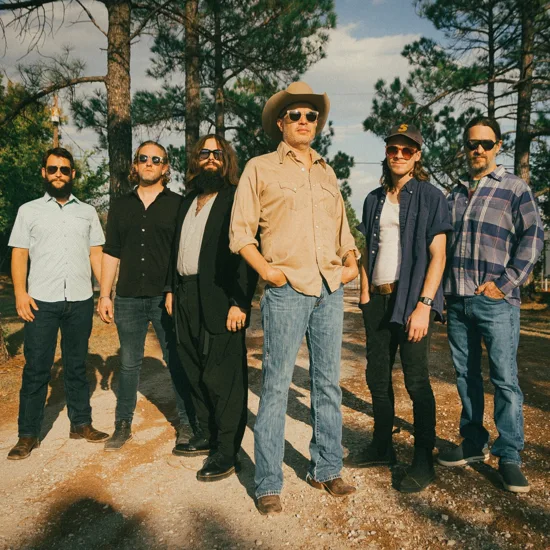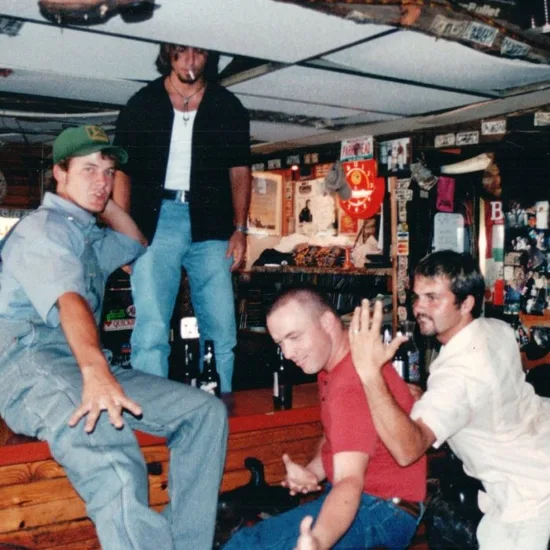
The Farm was a gathering place, not a preset sound
Official Oklahoma tourism identifies the Farm near Stillwater as a central place in the Red Dirt story. The Oklahoma Historical Society’s Schroeder family history supplies a different, valuable layer: the farmhouse had been a family home before heirs rented it to college students, and musicians later gathered there. The house burned in 2003. That is a historical connection, not an invitation to enter a private site or expect a preserved music attraction. The significance lies in people sharing songs outside a formal industry setting. A house can nurture a scene without every musician living there, every important session happening there, or every later band sounding alike. Start with that modest, powerful idea before attaching the label to a festival or playlist.12
Bob Childers: put the songwriter before the mythology
The Oklahoma Historical Society identifies Bob Childers as a foundational Red Dirt figure and documents his 1979 album I Ain’t No Jukebox, recorded with help from Jimmy LaFave. Its account also follows his movement through Nashville and Austin before his return to Oklahoma. That movement matters: a regional identity does not require an artist to stay within county lines. For a first listen, follow a complete Childers song through the verse rather than waiting only for a chorus payoff. Notice how a conversational delivery allows a surprising image or judgement to emerge gradually. The scene’s value was not merely refusing an outside industry. It was making room for writers whose phrasing, humour and subjects could remain individual while songs travelled between performers.3
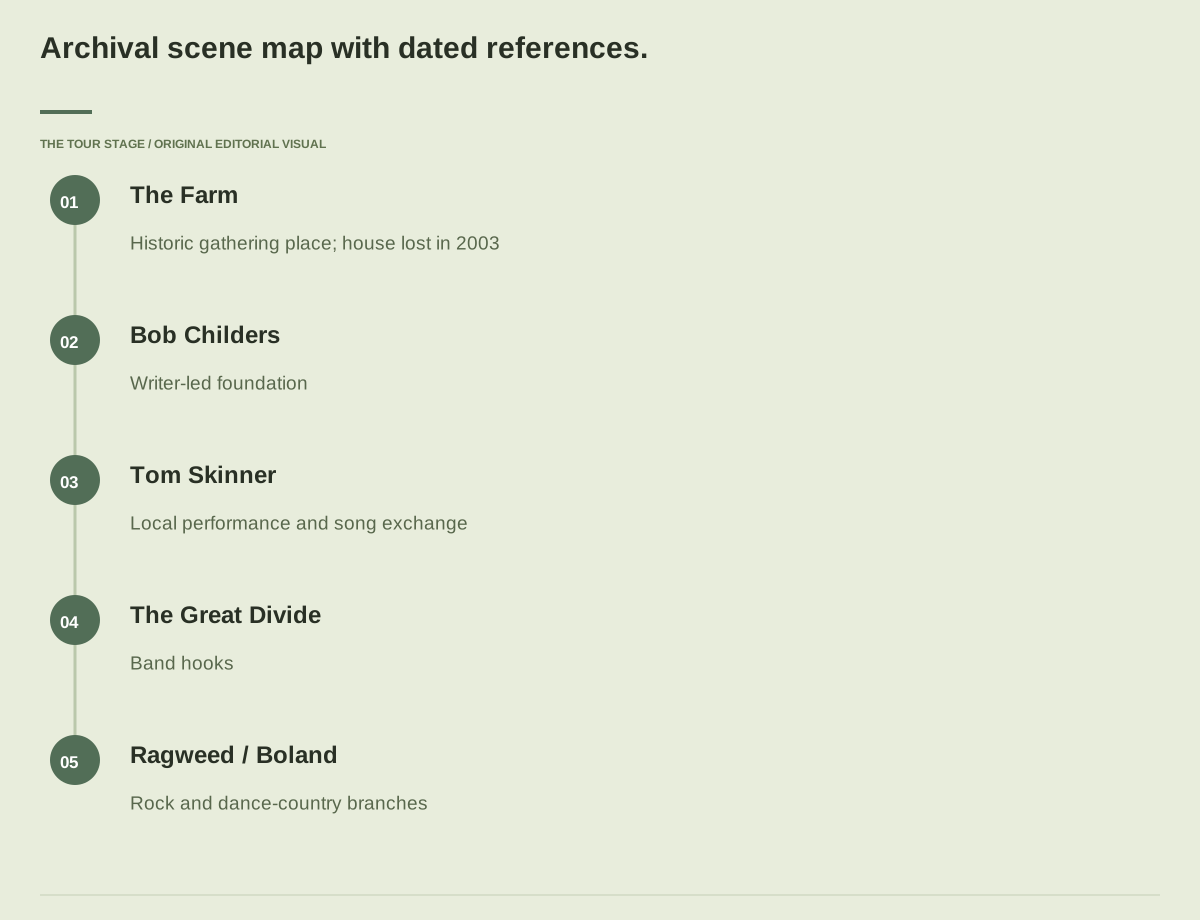
Archival scene map with dated references.
- The FarmHistoric gathering place; house lost in 2003
- Bob ChildersWriter-led foundation
- Tom SkinnerLocal performance and song exchange
- The Great DivideBand hooks
- Ragweed / BolandRock and dance-country branches
Read the visual as text
- The FarmHistoric gathering place; house lost in 2003
- Bob ChildersWriter-led foundation
- Tom SkinnerLocal performance and song exchange
- The Great DivideBand hooks
- Ragweed / BolandRock and dance-country branches
Tom Skinner and the circulation of songs
The Historical Society describes Tom Skinner as another originator and leader of the music around Stillwater, documenting his time at Oklahoma State and performances at Willie’s Saloon with the Skinner Brothers Band. This is a useful corrective to a history built only around later album sales. Open microphones, repeated encounters and local bands create opportunities for a song to acquire listeners before a national audience knows its writer. When exploring Skinner, listen to the unforced pacing of the singing, then ask how a louder band could preserve the centre of the song. The answer is not necessarily to imitate his voice. It may be to keep the lyric intelligible and the emotional turn intact while altering the rhythm or arrangement.4
The Great Divide: hooks within the community
The Great Divide provides an accessible band entry point. Put Break in the Storm beside the earlier writer-centred material rather than treating it as a replacement for it. The band context makes choruses, instrumental colour and the relationship between lead vocal and rhythm section easier to hear. A listener arriving from mainstream country may recognise the compact song architecture immediately, yet find a different balance of roughness and polish. Resist the temptation to convert that impression into a claim that every Red Dirt recording rejects production. Production is a set of choices, not a moral score. The useful comparison is how each record creates room for the singer’s personality and how the band builds momentum around it.
Ragweed and Boland take different roads
With Cross Canadian Ragweed, start with Soul Gravy and listen to the weight of the guitars and the elasticity of the band. Then move to Jason Boland & The Stragglers and Pearl Snaps, paying attention to the firmer dance-country vocabulary. The contrast is the point: shared audiences and relationships need not produce identical arrangements. One record may meet a rock listener through electric texture while another invites attention through the shape of a country vocal. Neither is a more authentic unit of Oklahoma soil. The country-and-rock band comparison follows that distinction into a later generation; the dance-hall guide explains why the beat also has a social function.
A listening map is not an access map
The Farm belongs on an interpretive map because of documented history. A currently operating club belongs on a visitor plan only after its own calendar confirms a suitable show. Oklahoma tourism points listeners toward places including Stillwater’s Tumbleweed and Tulsa’s Cain’s Ballroom, but Tulsa is a separate destination, not a neighbourhood of Stillwater. Do not stretch a short evening into a state-wide crawl. Search by artist as well as by venue, because the scene is carried by touring musicians. A regional festival may connect the generations more clearly than an unprogrammed visit to a famous building. Check the actual edition, set times, admission terms and age restrictions rather than assuming a historic association guarantees music on arrival.
Hear a scene in three passes
On the first pass, follow lyrics across three records: Childers, the Great Divide and Boland. On the second, attend only to the rhythm section. Which songs suggest dancing, which lean into a rock backbeat, and which leave phrases hanging in open space? On the third, examine the credits and compare any shared writers or musicians actually listed there. This keeps a listening route anchored in evidence rather than resemblance alone. A common lyric or writer credit can document a connection; a similar drawl cannot prove one. Make a small playlist with one representative track and one unexpected choice from each artist. The unexpected track is often the one that stops a regional label from becoming a stereotype.
What Stillwater adds to the records
A useful destination story explains why musicians could meet, exchange songs and form working relationships. It should not make landscape responsible for every musical decision. Stillwater’s college-town setting and the documented gathering places help explain circulation; the individual records explain the artists. Leave room for women, neighbouring communities, and musicians outside this deliberately limited introductory route when you continue researching. No five-name list can reproduce the whole network. What this route offers is a way to hear continuity without flattening difference: a songwriter’s patient detail, a band’s melodic lift, a rock guitar’s abrasion and a dance rhythm can all participate in the same social history. For another region with multiple musical identities, compare Kentucky’s songwriting connections.
Sources & further reading
- Oklahoma Music Trail: the FarmHistoric gathering place and regional venue context.
- Oklahoma Historical Society: Schroeder familyFamily-home history, later music use and 2003 fire.
- Oklahoma Historical Society: Bob ChildersRecord chronology and musical-community role.
- Oklahoma Historical Society: Tom SkinnerStillwater, OSU and Willie’s Saloon connections.