A route through contributions, not a league table
No short list can contain the women who made country music. A useful listening history instead identifies several different kinds of change: an interpreter establishes a vocal standard; a writer brings a neglected experience into a song; an artist makes production choices that travel across formats. These achievements overlap, but they are not interchangeable. Start with the record itself before checking a chart position, award or sales milestone. Ask whose perspective controls the story, where the singer places a phrase, and what the arrangement allows her to communicate. This route is deliberately selective. It offers starting points for exploration, not a claim that the artists omitted matter less. The first deep-listen album guide extends its range.
Patsy Cline: interpretation as authorship of a performance
The Country Music Hall of Fame identifies Patsy Cline as the first solo woman elected to its membership, in 1973, and documents the lasting reach of her singing.1 Hear “Crazy” for a more immediate explanation of her importance. The melody is not simply delivered at an even intensity: entrances, sustained vowels and small changes in pressure make confidence and uncertainty coexist. Listen once for the lead voice, then again for how the accompanying instruments leave it room. A singer does not have to write a composition to determine the emotional identity of a recording. Cline is an essential opening example precisely because the listener can hear the creative work in phrasing. Compare her calm surface with the turmoil suggested by the song’s situation without reducing either to biography.
Selected milestones, different kinds of change
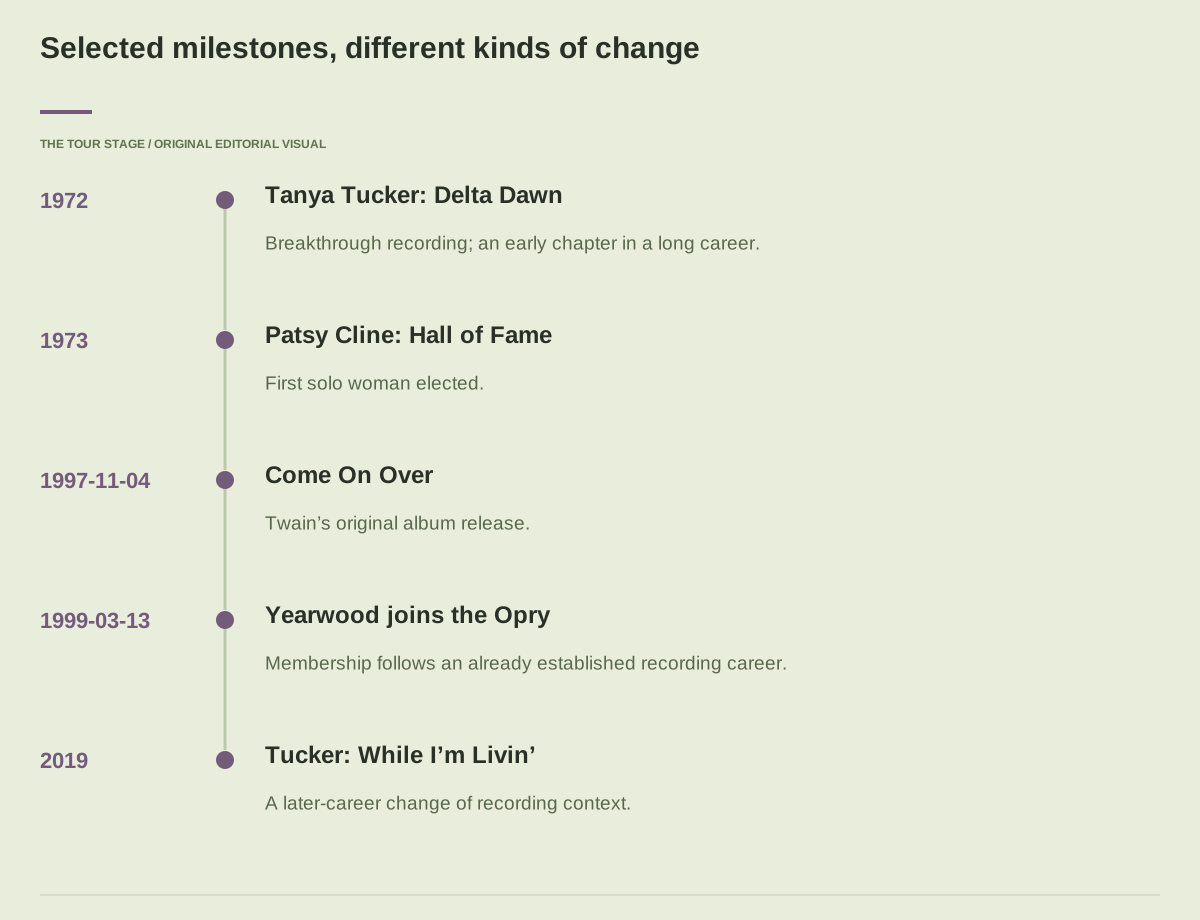
- 1972 · Tanya Tucker: Delta DawnBreakthrough recording; an early chapter in a long career.
- 1973 · Patsy Cline: Hall of FameFirst solo woman elected.
- 1997-11-04 · Come On OverTwain’s original album release.
- 1999-03-13 · Yearwood joins the OpryMembership follows an already established recording career.
- 2019 · Tucker: While I’m Livin’A later-career change of recording context.
Read the visual as text
- 1972 · Tanya Tucker: Delta DawnBreakthrough recording; an early chapter in a long career.
- 1973 · Patsy Cline: Hall of FameFirst solo woman elected.
- 1997-11-04 · Come On OverTwain’s original album release.
- 1999-03-13 · Yearwood joins the OpryMembership follows an already established recording career.
- 2019 · Tucker: While I’m Livin’A later-career change of recording context.
Loretta Lynn: the narrator sets the terms
Loretta Lynn’s museum history connects her songwriting to an unusually direct personal and social perspective.2 “Coal Miner’s Daughter” is an entry point into writing that turns remembered domestic detail into an authoritative first-person account. The details establish a community rather than functioning as decorative proof of rural authenticity. On a second listen, notice the relationship between the conversational delivery and the regular pulse: the story moves because the voice sounds capable of speaking it naturally. Then compare a confrontation song such as “You Ain’t Woman Enough.” Its force comes from control of the scene and the address, not simply from a louder vocal. Lynn makes the narrator a person who can define her own position. That is a musical and dramatic contribution as well as a thematic one.
Dolly Parton: a writer’s eye and a flexible voice
The museum’s Parton biography follows a career that joins songwriting, country performance and work across popular entertainment.3 “Coat of Many Colors” is a compact lesson in building a large emotional consequence from one concrete object. Listen for how the story supplies the object’s meaning before its social significance becomes clear. “Jolene” creates a different kind of tension through repetition and a tightly focused address. The two performances demonstrate that narrative detail and memorable pop construction need not compete. Parton’s bright vocal timbre also complicates a lazy assumption that a light sound communicates only light feelings. Try describing the emotional movement in plain verbs—remembering, asking, defending—before reaching for a genre label. That approach makes the songs’ craft easier to hear.
Tanya Tucker: a voice that keeps changing its context
Tanya Tucker entered this history through “Delta Dawn” in 1972; the museum’s Hall of Fame materials place that breakthrough within a much longer career.4 Compare the story-song poise of that early recording with the reflective atmosphere of “Bring My Flowers Now,” released on While I’m Livin’ in 2019. The comparison is not a contest between a young voice and an older one. It shows how grain, pacing and the position of the narrator can change the listener’s relationship with a singer. An established artist can use continuity of vocal character while revising the setting around it. Hear where a line seems to resist the beat, and whether the arrangement underlines that resistance or simply gives it space. Career longevity becomes audible through those decisions.
Trisha Yearwood: scale without losing the story
For Trisha Yearwood, begin with “She’s in Love with the Boy” and follow the story’s changing balance between youthful certainty and parental judgment. The Opry’s artist record documents both her established career and her 1999 membership.5 Her singing is a useful reminder that vocal power is not synonymous with continual maximum volume. Listen to the progression from conversational detail into an expansive chorus, then to the return to a smaller scene. A large voice can preserve a character’s specific point of view. Place Yearwood next to Cline in a listening session and identify a shared technique rather than declaring them stylistically identical. Both make an unfolding emotional argument through choices of emphasis. The ballad listening guide offers more ways to hear that restraint.
Shania Twain: production becomes part of the statement
Shania Twain’s Come On Over appeared in 1997; its official reissue distinguishes the US and international editions rather than treating every version as one interchangeable object.6 Start with the original US sequence when examining its country-pop construction. “Man! I Feel Like a Woman!” makes an immediate entrance through its instrumental hook, while “You’re Still the One” gives the vocal a softer frame. The contrast shows how an album can hold different kinds of confidence. Listen for rhythm, stacked voices and the division of space between a guitar figure and a sung phrase. Those details explain crossover more precisely than the idea that an artist simply left one audience for another. Different mixes and editions are also a reason to record exactly which version you heard.
Miranda Lambert and the next listening question
Miranda Lambert provides a later route into character writing, band texture and the productive tension between vulnerability and defiance. Begin with “The House That Built Me,” then move to the harder attack of “Kerosene.” The first listening question is about the performance rather than whether both songs have the same writing credits. Keep a small notebook with three columns: the narrator’s position, the most telling vocal choice, and the arrangement’s response. Add a woman whose recordings differ sharply from the preceding artist. The aim is a history that grows through comparison, not an isolated celebration repeated once a year. Follow the songwriters and interpreters guide to separate composition from performance, and use the monthly discovery calendar to keep expanding the route.
Sources & further reading
- Country Music Hall of Fame: Patsy ClineVocal legacy and 1973 election.
- Country Music Hall of Fame: Loretta LynnSongwriting perspective and career.
- Country Music Hall of Fame: Dolly PartonSongwriting and cross-format career.
- Country Music Hall of Fame: 2023 inductionTucker breakthrough and career context.
- Opry: Trisha YearwoodCareer and induction date.
- Shania Twain official Come On Over reissueOriginal US sequence and edition distinctions.