Use twelve months as a rhythm, not a deadline
This is an evergreen editorial listening project. Month one can begin in January, November or whenever you have room to listen. None of the entries predicts an album release, concert date or festival appearance. Each points to an existing record documented in the artist’s official catalogue. Give each theme two or three short sessions: a first impression, a focused comparison and a return without notes. Mark a month complete when it has given you a useful question or observation, rather than when you have memorised every credit. The on-device save, print and JSON-download controls help you retain the project. They do not create calendar reminders or send emails. If you miss a month, resume with the next theme; the sequence remains a useful route without becoming another obligation.
Narrators and small details
Start the project with Brandy Clark and 12 Stories. Her official catalogue provides the album entry.1 Choose a different song for each of two sessions, then write down who is speaking and what they want. Notice how a small object, a place or an action can establish a larger situation. Avoid replacing that observation with a label such as relatable. The story-song guide gives you a vocabulary for narrator, conflict and consequence. At the end of the month, select one track to revisit after the other eleven projects.
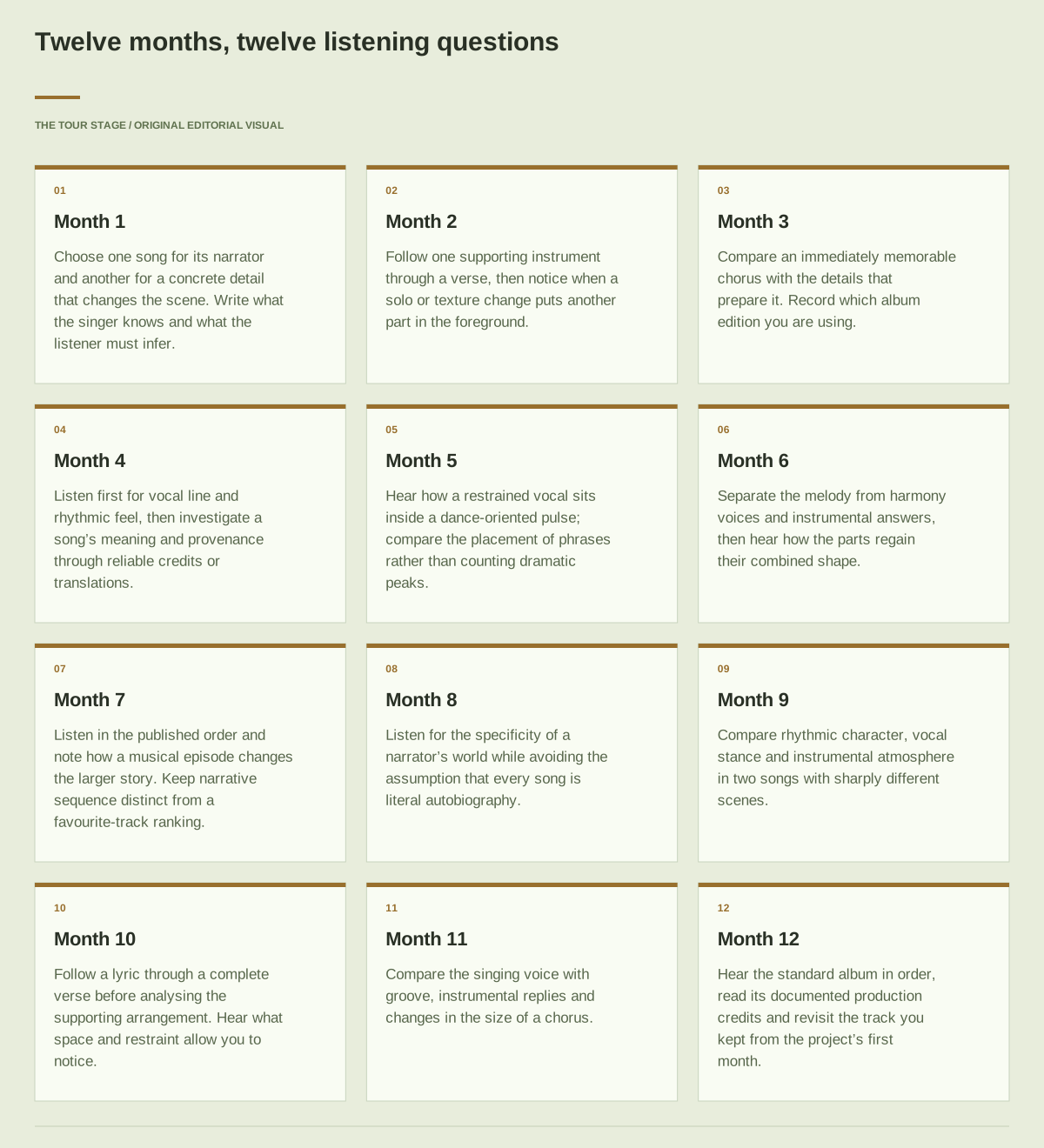
Twelve months, twelve listening questions
- Month 1Choose one song for its narrator and another for a concrete detail that changes the scene. Write what the singer knows and what the listener must infer.
- Month 2Follow one supporting instrument through a verse, then notice when a solo or texture change puts another part in the foreground.
- Month 3Compare an immediately memorable chorus with the details that prepare it. Record which album edition you are using.
- Month 4Listen first for vocal line and rhythmic feel, then investigate a song’s meaning and provenance through reliable credits or translations.
- Month 5Hear how a restrained vocal sits inside a dance-oriented pulse; compare the placement of phrases rather than counting dramatic peaks.
- Month 6Separate the melody from harmony voices and instrumental answers, then hear how the parts regain their combined shape.
- Month 7Listen in the published order and note how a musical episode changes the larger story. Keep narrative sequence distinct from a favourite-track ranking.
- Month 8Listen for the specificity of a narrator’s world while avoiding the assumption that every song is literal autobiography.
- Month 9Compare rhythmic character, vocal stance and instrumental atmosphere in two songs with sharply different scenes.
- Month 10Follow a lyric through a complete verse before analysing the supporting arrangement. Hear what space and restraint allow you to notice.
- Month 11Compare the singing voice with groove, instrumental replies and changes in the size of a chorus.
- Month 12Hear the standard album in order, read its documented production credits and revisit the track you kept from the project’s first month.
Read the visual as text
- Month 1Choose one song for its narrator and another for a concrete detail that changes the scene. Write what the singer knows and what the listener must infer.
- Month 2Follow one supporting instrument through a verse, then notice when a solo or texture change puts another part in the foreground.
- Month 3Compare an immediately memorable chorus with the details that prepare it. Record which album edition you are using.
- Month 4Listen first for vocal line and rhythmic feel, then investigate a song’s meaning and provenance through reliable credits or translations.
- Month 5Hear how a restrained vocal sits inside a dance-oriented pulse; compare the placement of phrases rather than counting dramatic peaks.
- Month 6Separate the melody from harmony voices and instrumental answers, then hear how the parts regain their combined shape.
- Month 7Listen in the published order and note how a musical episode changes the larger story. Keep narrative sequence distinct from a favourite-track ranking.
- Month 8Listen for the specificity of a narrator’s world while avoiding the assumption that every song is literal autobiography.
- Month 9Compare rhythmic character, vocal stance and instrumental atmosphere in two songs with sharply different scenes.
- Month 10Follow a lyric through a complete verse before analysing the supporting arrangement. Hear what space and restraint allow you to notice.
- Month 11Compare the singing voice with groove, instrumental replies and changes in the size of a chorus.
- Month 12Hear the standard album in order, read its documented production credits and revisit the track you kept from the project’s first month.
Acoustic handoffs
Use Billy Strings’ Home for an ensemble-focused month. The official album page documents its track list.2 On the first listen, follow the guitar; on the second, deliberately choose another part. Ask how the accompaniment keeps motion going while attention moves elsewhere. This is a listening exercise rather than a test of how quickly you can identify every player. Connect the record with the bluegrass and country comparison. Your useful note is a description of a handoff or a supporting rhythm, not simply the word fast.
Hooks and recording versions
Explore Shania Twain’s Come On Over through a clearly identified edition. The official anniversary listing distinguishes the original album material from bonus duets, live recordings and remixes.3 Keep those versions separate in your notes. Choose a chorus that stays with you, then return to the verse and hear how its rhythm and melodic movement prepare the hook. A repeated phrase can sound inevitable because the surrounding arrangement makes room for it. Use the country-pop guide to extend the comparison without treating crossover as a single production formula.
A voice across languages
Choose En Español by The Mavericks. The band’s official news archive identifies the Spanish-language project.4 Let the first session focus on musical phrasing and ensemble movement, especially if Spanish is unfamiliar to you. For a later session, investigate one song’s meaning through a reliable translation and check the recording’s credits. Do not assume a song is newly written because the performance is new to you. Compare what you heard before and after learning more. This month asks how musical expression reaches a listener while recognising that understanding words adds another important dimension.
Measured country phrasing
Choose Strait from the Heart from George Strait’s documented discography.5 Listen for the relation between the regular accompaniment and the way the singer begins or ends a phrase. A calm delivery still contains decisions about emphasis, timing and the shape of a held note. Compare two songs rather than assuming every track uses restraint in the same way. The honky-tonk guide connects that attention to dance rhythm and room. Keep a note describing a phrase that feels conversational and explain which musical detail creates that impression.
Harmony and instrumental space
For the sixth month, explore So Long So Wrong, credited to Alison Krauss & Union Station in the official catalogue.6 Follow a single harmony entrance and listen to what changes when it joins the melody. In another passage, follow the instrumental reply instead. The point is to understand cooperation, not to take a rich texture apart permanently. After examining the parts, listen again without notes and hear the whole. The harmony explainer offers further prompts. Describe blend through timing and phrase shape as well as vocal tone.
A story across an album
Use Sturgill Simpson’s The Ballad of Dood & Juanita for a month about album-scale narrative. His official Bandcamp release provides the sequence and recording context.7 Hear it in order once before selecting favourite moments. On a second pass, write a brief account of what each episode contributes to the whole. Pay attention to how pace and instrumental colour help distinguish situations. The sequencing guide supplies a useful companion. This is a different task from ranking tracks: a passage can matter to the story even when another is your preferred standalone song.
Place in a singing voice
Choose Purgatory from Tyler Childers’ official catalogue.8 Listen to how vocal inflection and concrete references give a song a particular world. Keep the singer, songwriter and narrator distinct: a compelling first-person performance does not make every detail an autobiographical statement. Compare one forceful delivery with a quieter passage and notice how the relationship to the listener changes. Read the Kentucky listening route for a broader geographical context. Your month’s note should identify an audible or textual choice, rather than using birthplace as a substitute for analysis.
Roots colour and dramatic delivery
Explore Trail of Flowers by Sierra Ferrell. The official release page lists its songs and production credits.9 Compare the atmosphere of two tracks before deciding what connects them. A striking voice can remain recognisable while changes in rhythm, texture and dramatic address create different worlds. Notice where a phrase turns toward the listener and where an instrumental figure carries the momentum. The country and Americana comparison can help frame the overlap without locking the record into one box. Keep the specific musical contrast at the centre of your notes.
Clarity and narrative patience
Take I Travel On from Jason Eady’s official music catalogue.10 Let one song finish before making a judgment about its pace. Then listen to the opening again and notice how much information the early phrases establish. Follow the accompaniment as a supporting conversation: an instrumental response can deepen a pause without competing with the next line. This month rewards a short listening session with full attention rather than a large playlist running in the background. Compare your notes with those from Brandy Clark in the first month, especially the different ways a narrator establishes authority.
Personality in a full-band record
Choose Bell Bottom Country from Lainey Wilson’s official music page.11 Listen for how a vocal personality remains clear when the arrangement becomes larger. Select a verse-to-chorus transition and describe what changes: rhythmic weight, instrumental density, melody or the singer’s address. Do not assume every sense of lift comes from increased volume. Return to the guitar-tone guide if a particular electric texture draws you in. End the month by choosing one track you would share with a friend and a specific musical reason for sharing it.
Sequence, credits and a return visit
Finish the first cycle with Kacey Musgraves’ Golden Hour. The official track list identifies the standard sequence.12 Use the annotated album guide to connect changes in musical scale with the placement of tracks. Then return to your saved Brandy Clark song from month one. Listen before reading your original note and ask whether your attention has changed. This comparison is the project’s real conclusion: a year of different questions may help you hear an already familiar performance more precisely. Choose the next cycle from the qualities you now want to explore.
Keep a small record of what changed
Use three lines for each completed month: the record and edition, one musical detail, and one connection you want to follow. Keep your own taste separate from claims about historical importance. You may admire a performance without wanting to hear it every day, and you may enjoy a record before knowing much about its context. At the end, compare two notes that seem far apart, such as acoustic handoffs and pop hooks. A rhythmic or vocal quality may connect them. The artist finder and sound-preference quiz offer additional editorial routes. Start a second cycle by changing one record per theme, keeping the questions that made you more attentive and replacing those that did not.
Sources & further reading
- Brandy Clark official 12 Stories entryExisting album and listening link.
- Billy Strings official Home pageHome track list and album entry.
- Shania Twain official Come On Over anniversary listingOriginal material and bonus-version distinction.
- The Mavericks official En Español news archiveSpanish-language album context.
- George Strait official discographyStrait from the Heart catalogue entry.
- Alison Krauss official music catalogueSo Long So Wrong album entry and artist credit.
- Sturgill Simpson official Bandcamp releaseThe Ballad of Dood & Juanita sequence and release context.
- Tyler Childers official Purgatory releaseExisting Purgatory album.
- Sierra Ferrell official Trail of Flowers releaseTrack list and production credits.
- Jason Eady official music catalogueI Travel On album entry.
- Lainey Wilson official music catalogueBell Bottom Country album entry.
- Kacey Musgraves official Golden Hour track listStandard thirteen-track sequence.